
Context Engineer Is the Title of 2026. The Discipline Is a Century Old.
It didn't exist as a title in 2023. The discipline underneath it is a century old. Map your atom, not your title.

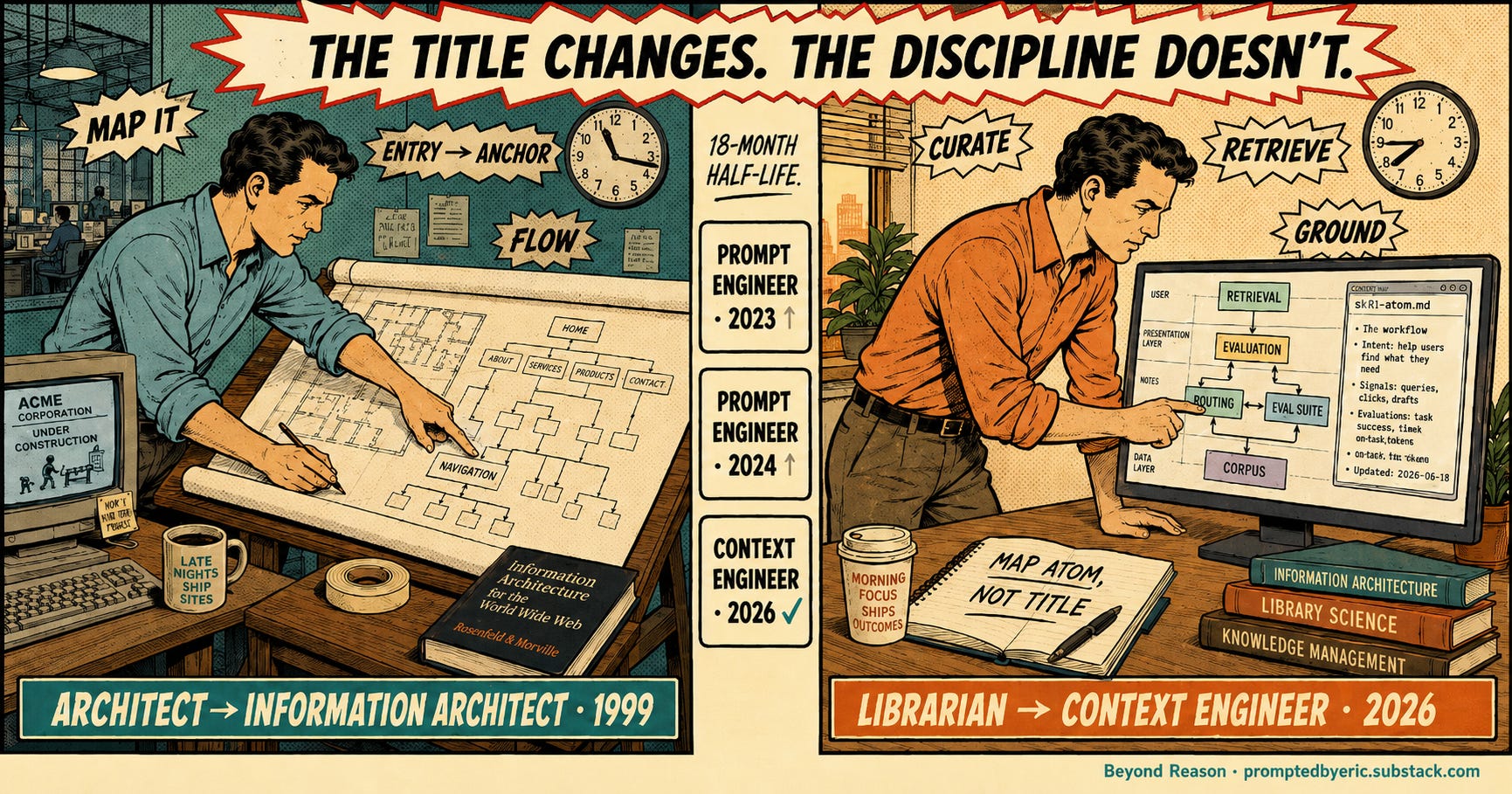
TL;DR. The jobs of the future are transformed jobs of the present. Titles churn every 18 to 36 months. The cognitive atomic unit beneath them doesn’t change. That skill atom is what a librarian, an architect, or a copy editor actually does when you strip the tools away. Prompt engineer died in 18 months because it had no atom underneath. Context engineer is thriving because library science, knowledge management, and information architecture have been doing the work for a century. The lesson for anyone watching their role get rewritten by AI: map your atom, not your title.
The Architect Who Wasn’t
The first time I watched a building architect become an information architect, I was at Agency.com in the late 1990s. We had a client problem that didn’t have a name yet. Corporate websites were exploding in size, sometimes by a factor of ten in a single year, and nobody knew how to organize them. We tried hiring web designers. We tried hiring librarians. Neither group could hold the whole shape of a thousand-page site in their head and tell you where the user was getting lost.
So we hired architects. Real architects: the kind who design office buildings, hospitals, retail stores. The first one walked into the office with a roll of trace paper and started sketching circulation patterns the way you’d map foot traffic through a museum. Entry. Wayfinding. Anchor destinations. The places people back away from a hallway because something about it tells them they shouldn’t be there. Two weeks later he had a job title nobody had used the year before: information architect.
He didn’t become a web person. He stayed an architect. The discipline transferred because the underlying skill, organizing complex hierarchies so a human can find their way through them, turns out to be the same problem whether the hierarchy is made of drywall or hyperlinks.
That hire is the pattern I want to talk about, because we’re doing it again.
The Same Pattern, Five Times in a Row
Morgan Stanley’s April 2026 analysis walked through the last 150 years of labor transitions and reached a conclusion that should be the default null hypothesis on every panel about AI and work: sweeping technological shifts altered the labor force, but they did not replace it. Electrification. The tractor. The computer. The internet. Each one rearranged who did what, and each one created more work than it eliminated. The mechanism repeated every time: existing roles absorbed new capabilities, and the title evolved to mark the shift.
The spreadsheet is the cleanest example. When VisiCalc and then Lotus 1-2-3 hit corporate accounting in the early 1980s, the easy prediction was that bookkeepers were finished. Not quite. The manual-ledger work compressed, but the bookkeeping atom, quantitative judgment under uncertainty about money, didn’t go anywhere. The spreadsheet just freed it from the ledger. The bookkeeper got a prefix. The prefix was financial analyst. The job expanded.
Web era (1995–2005): architect to information architect. Librarian to digital librarian. Designer to web designer. Mobile era (2007–2015): developer to mobile developer. Marketer to growth marketer. Cloud era (2010–2020): sysadmin to DevOps engineer. Network engineer to cloud architect.
The receipts compound. Whatever the prefix is, the discipline underneath is older than the prefix.
The Prefix Showing Up Right Now
The 2026 example is context engineer, and it’s no longer a hypothetical.
The example many cite is Cognizant’s. On August 29, 2025, it announced it would deploy 1,000 context engineers over the following year, powered by Workfabric AI’s ContextFabric platform. Read that for what it is: a services firm and a pre-seed software vendor co-marketing a platform launch, with the headcount as the commitment signal. It’s the systems-integrator version of “we’re certifying 5,000 consultants.” Cognizant’s CEO, Ravi Kumar S, said the quiet part out loud: “Every technology shift creates a services shift. In the LLM era, the lever is context.” A services shift, in his own words. Nine months later, I can’t find a public update confirming progress against the thousand, Workfabric still looks early-stage, and by its Q1 2026 earnings call Cognizant was talking about “forward-deployed engineers” under a Google Cloud Gemini partnership instead. Which is the tell I flagged the first time through: a platform with a name in it is a vendor surface, and vendor surfaces become walled gardens. The prefix already churned, context engineer to forward-deployed engineer, before the first thousand shipped. The title and the platform are the wrappers; the discipline is the part that lasts. And the signal that it’s real doesn’t come from one press release: Gartner has since published a formal definition of context engineering, and Phil Schmid’s practitioner essay put it on the field’s mental map: “The new skill in AI is not prompting. It’s context engineering.”
Aaron Levie at Box has been making the same call from the enterprise side. His framing, the “era of context”, argues that AI agents are only as good as the context they receive, and that the scarce resource isn’t compute or model quality. It’s structured, domain-specific context. Read his version next to what’s happened since, and the picture is hard to miss: a category of work that didn’t have a name eighteen months ago is becoming a profession. Analysts are defining it, practitioners are naming it, and the frontier labs, not just one services firm, are staffing it.
And it isn’t just Cognizant. In May 2026, three weeks before this piece publishes, both frontier labs made the same play in the same week. On May 4, Anthropic, Blackstone, Hellman & Friedman, and Goldman Sachs announced a new enterprise AI services company; Reuters and CNBC reported the venture at about $1.5 billion, with Claude engineers embedded inside private equity portfolio companies. One week later, on May 11, OpenAI announced the OpenAI Deployment Company — a majority-owned business unit with more than $4 billion in initial investment, led by TPG and including Bain Capital, Bain & Company, Brookfield, Goldman, McKinsey, and Capgemini. OpenAI also announced an agreement to acquire Tomoro, subject to approvals: roughly 150 forward-deployed engineers with customers including Tesco, Virgin Atlantic, and Supercell. The shape of both moves is the same: forward-deployed engineers inside customer workflows, doing the work of getting a model to ship inside a real business with real data and real compliance constraints.
The frontier labs are saying out loud what Cognizant said in August. The model is the commodity. Forward-deployed engineering is the margin. The big bet of 2026 isn’t on whose model is smartest. It’s on who stands up the most embedded engineers fastest — and which existing disciplines those engineers come from.
What does a context engineer actually do? They curate the corpus the AI reasons over and design the retrieval logic. They build evaluation suites that catch when the model drifts, and write the routing rules that get the right document to the right agent at the right moment. None of that work is new. It’s library science, information architecture, knowledge management, and SRE-grade observability with an AI layer on top. It’s also the labor-side of two arguments I’ve made before in this newsletter — that skills are the new software (markdown-encoded institutional knowledge as the unit of leverage) and that knowledge work is code (treat context like source code; the file is the memory). Context engineering is what shows up on payroll when both arguments find a hiring manager. These hires won’t come from a context-engineering bootcamp. They’ll come from the people who already had the atom and now have a place to apply it.
The Punchline: Prompt Engineer vs. Context Engineer
Prompt engineering peaked in the 2023 hype cycle. WSJ ran a “talking to chatbots is now a $200K job” piece in November 2023. Forbes covered $300K-plus salaries that summer. By May 2025, Fortune was reporting that the standalone title was fading, and a 2025 arXiv analysis found prompt-engineering roles remained rare in sampled postings. The work didn’t disappear. It got absorbed into the ordinary skill stack of every developer who builds with LLMs — to the extent the work was real to begin with.
Context engineering is on a different arc. It wasn’t a visible job-market category in 2023, and it was still fringe in 2024. By 2026 it had an analyst category, a name practitioners had settled on, and the frontier labs hiring for it. The early indication is that this one sticks.
Why? Because prompt engineering was rootless. It was a skill in search of a domain. The atoms it required (knowing what an LLM responds to, what phrasing produces what output) collapsed into model defaults the moment the models got better at receiving sloppy input. There was no underlying craft for prompt engineering to land on. The prefix had nothing to attach to.
Context engineering is rooted. The atoms (curation under disagreement about what matters, taxonomies, retrieval-quality judgment, evaluation under volume) have a century of library and IA practice behind them. Wurman coined “information architect” in 1976. Rosenfeld and Morville published the canonical text in 1998. When Cognizant goes hiring, I doubt they look for people who took a context engineering certificate course. Instead, they look for people who already knew how to organize complex information and can now do it with a model in the loop.
The title is what hiring managers post. The skill underneath is what survives when the title churns. Optimize for the title on a two-year horizon. Optimize for the skill on a ten-year one. Confuse the two and you’ll spend a career chasing titles that compress under you.
Jensen Said It Best
Jensen Huang gave the sharpest version of this on Lex Fridman’s podcast, episode 494, posted March 23, 2026. The exact wording matters, because the Fortune paraphrase that ran a week later is softer than the line:
I just want to remind them that the purpose of your job, and the tasks and tools that you use to do your job, are related, not the same.
He went straight to radiology to make the point. His account: imaging models crossed what he calls the superhuman threshold around 2020, computer scientists predicted AI would take radiology first, and today AI is embedded across major radiology workflows. The independent data backs the labor half of that — the radiologist shortage is well-documented in 2025 Nature and RSNA coverage, and the headcount has grown rather than shrunk (the ACR puts it up 17 percent from 2014 to 2023). The atom underneath radiology was never “look at a film.” It was “make a diagnostic judgment under uncertainty using whatever instrument I have.” The instrument changed. The atom got more valuable, not less.
The compressed version, which I’ve used in talks for the last year: your judgment, not your typing speed, is what people are paying for. Typing speed was always a proxy. AI removes the proxy and exposes the underlying question. What judgment do you exercise that the model cannot? If the honest answer is none, the prefix won’t save you. If the honest answer is specific, durable, atom-shaped, then the prefix is yours to earn.
Translation: AI doesn’t replace jobs. It exposes which parts of your job were actually the job.
Where the Thesis Bends
Four places it bends: magnitude, durability, scope, access. In that order.
1. Magnitude: Acemoglu’s “so-so automation”
Daron Acemoglu’s Simple Macroeconomics of AI (NBER 32487, 2024) puts the upper-bound TFP gain at about 0.66 percent over ten years, closer to 0.53 percent if you include hard-to-learn tasks. GDP impact lands at roughly 0.93 to 1.16 percent over the decade under modest investment, rising to 1.4 to 1.56 percent under a larger AI investment boom. Goldman Sachs’s much-cited 7 percent global GDP projection is an order of magnitude higher.
Acemoglu’s case rests on what he calls “so-so automation”: applications that perform at best a little better than humans but save money. Call-center automation isn’t more productive than people. It costs less than people. His sharper claim: AI is being used “too much for automation and not enough for providing expertise and information to workers.”
Where it bites: the wage premium for the new prefix may not be what the wage premium was for the architect-to-IA move in 1999. Recombination may happen at compressed pay. Where it doesn’t bite: Acemoglu’s critique is about magnitude, not existence. The transformation happens. The check on the Goldman-style hype is healthy, not fatal.
2. Durability: Recursive collapse
Every AI job title coined in 2025 and 2026 assumes the AI of 2025 and 2026: Anthropic’s memory primitives, Claude Code’s automatic context management, OpenAI’s stateful API. Each of these compresses the work that defines today’s role. Prompt engineer peaked and died in 18 months because the models got better at parsing imprecise input. Context engineer could follow the same arc when the models get better at managing their own context. They will.
So the title is unstable. Granted. The atom isn’t. Curation under disagreement about what matters doesn’t get easier when the AI’s context window grows; it gets harder, because the choice of what to put in the window becomes more consequential, not less. The librarian’s skill, the IA’s skill, the SRE’s evaluation discipline — those persist through whatever we call the 2028 layer. The people most prepared for the next decade aren’t the ones who hold the current title. They’re the ones who can name their atom and re-attach it to whatever prefix comes next.
There’s a mechanism under this, and Erik Brynjolfsson named it. AI is unusually good at one specific thing: taking tacit knowledge — what a senior person knows but never wrote down — and making it explicit. In his call-center study, the model mined years of transcripts and handed the best answers to everyone; the junior reps jumped, and the senior reps shrugged, because the system was just playing back what they already knew. So the atom that survives the next collapse is the judgment that hasn’t been codified yet. Curation under disagreement qualifies. “Knows the standard answer” does not — that’s the first thing the model writes down.
“Context librarian” is actually a sharper coinage than “context engineer.” It puts the discipline first. (I called it that last week before doing the research; turns out being slightly wrong on the consensus term was useful.)
3. Scope: Embodied labor and Karp’s wedge
Alex Karp, in a TBPN interview on March 12, said the line that lit up that week: “There are basically two ways to know you have a future. One, you have some vocational training. Or two, you’re neurodivergent.” It read as provocative; however, the data underneath is harder than his framing suggests. BLS 2024–2034 employment projections have services for the elderly and persons with disabilities adding 528,500 jobs — the largest of any detailed industry, at +21 percent growth. Healthcare and social assistance overall is the fastest-growing sector. Skilled-trades demand is up 27 percent over four years, per Randstad. Jensen made the same point in May 2026: “Electricians, plumbers, iron workers, technicians, builders — this is your time.”
The cognitive recombination story applies to maybe a third of the labor force — though weighted by economic value, that third punches well above its headcount share. The rest is physical, embodied, locally delivered, and demographically driven: aging population, energy transition, data center buildout, housing. Both stories hold at the same time. Talking about jobs of the future without leading with eldercare and the trades is a class-bound conversation, not an empirical one. The prefix thesis bounds itself to knowledge work, and saying so explicitly is the responsible move.
Karp’s neurodivergent angle is the same point in disguise. He’s claiming cognitive diversity is a scarce input in an AI economy. That is an atom claim. He just packaged it weirdly.
4. Access: The broken ladder
This one doesn’t refute the thesis. It marks a boundary the thesis has to acknowledge to stay honest.
Ravio’s 2025 European tech labor data put entry-level hiring down 73 percent year-over-year across European tech. The mechanism is the death of what workforce researchers call the paid learning curve: the era when employers subsidized junior development by paying people to do rote work that doubled as training. AI automates exactly that rote work. People still have to earn the atoms; the on-ramp for earning them is collapsing.
The American data says the same thing with a sharper edge. Stanford’s Erik Brynjolfsson, Bharat Chandar, and Ruyu Chen (in a paper they titled “Canaries in the Coal Mine“) found employment for 22-to-25-year-olds in the most AI-exposed jobs down about 13 percent in the August 2025 version, and 16 percent in a later revision after firm-level adjustments, while older workers in the same roles held steady or grew. The paper accounts for the obvious confounders, the pandemic and interest rates, and the decline still lines up with the window where the models got good enough to matter, not ChatGPT’s 2022 launch. The ladder isn’t breaking for everyone. It’s breaking for the people on the bottom rung.
The thesis describes what happens to roles. The broken ladder describes what happens to pipelines. Both hold simultaneously, and the broken ladder intensifies the thesis: when fewer people earn the underlying skill each year, the ones who already have it command a premium.
Brynjolfsson thinks the ladder may rebuild itself: once universities teach students to work with Cursor and Replit instead of around them, the AI-native graduate becomes the hire who crushes it. Maybe. But that is a bet on institutions moving fast, and institutions move at institutional speed.
The emerging response is AI apprenticeship: paid programs that train orchestration and verification of AI output rather than the rote work the AI now handles. U.S. Department of Labor data shows registered tech apprenticeships up 29 percent over five years, with more than 64,800 apprentices served in technology occupations in 2024. Accenture says apprenticeships have made up 20 percent of its entry-level hiring across the U.S. and Canada over the past four fiscal years. That’s the rebuild. It works at small scale; it has to work at much larger scale. This is the policy crisis sitting under the labor data, and it’s where the most useful work of the next five years happens.
What This Means If You’re Watching Your Role Get Rewritten
Map your atom, not your title. Name the cognitive atomic unit underneath your current role. Not the deliverables. Not the tools. The underlying judgment. If you can’t name it in one sentence, that’s the work to do this month. Once you have it, you stop reading every new AI capability as a threat and start reading it as a new prefix you can attach to.
Don’t optimize for AI-native titles from scratch. The pattern is consistent: the titles that survive prefix an existing craft. The titles that don’t, don’t. If you’re choosing between “context engineer” (rooted) and the next bootcamp-grad title without a discipline underneath it, take the rooted one every time. The atom underneath the prefix is what makes the prefix sticky.
Earn the prefix. Don’t wait for it. Jensen’s other line, you won’t lose your job to AI, you’ll lose it to your coworker who uses it, is a competitive threat wearing career-advice clothes. The radiologist who learned AI-assisted diagnostics got the prefix. The one who didn’t became the cautionary tale. Nobody handed the information architect at Agency.com his title in 1999. He earned it by being the person who could already think in spatial hierarchies, and then learned to draw them in HTML.
The discipline transferred. It always does.
The Architect Is Still Working
The real contrarian view isn’t that AI will eliminate jobs. It’s that the job titles Silicon Valley invents from scratch (the ones that sound like the future, the ones with $200K salary screenshots and breathless coverage) are the ones that die first. Prompt engineer is the case study. The made-up, AI-native title lasted 18 months because there was no underlying craft for it to land on.
The titles that survive come from existing professions absorbing a new capability, the way they always have. Library science gave us context engineering. Radiology gave us a profession that absorbed the imaging revolution and grew rather than shrank. Whatever we call the 2028 layer, the people doing it will be the people who already had the atom in 2024 and stayed patient enough to keep updating the prefix.
That’s the prediction. It’s more boring than the futurists think. It’s also more promising than the pessimists fear. The architect who walked into Agency.com with a roll of trace paper in 1999 is still working today. He has a different title now, and he has it for the same reason he got it then.
He doesn’t have an AI job. He has a job, and he works with AI.
Receipts
Primary academic:
Daron Acemoglu, The Simple Macroeconomics of AI, NBER WP 32487 (2024). The magnitude check on AI productivity claims.
David Autor, Applying AI to Rebuild Middle Class Jobs, NBER WP 32140 (2024). The expertise-extension mechanism that makes the prefix thesis work economically.
Empirical and institutional:
BLS Employment Projections 2024–2034. Eldercare +528,500 jobs. Healthcare sector +8.4 percent. The embodied-labor anchor.
BCG: AI Will Reshape More Jobs Than It Replaces (April 3, 2026). 165 million US jobs analyzed; 50–55 percent reshaped vs. 10–15 percent eliminated.
Morgan Stanley: AI and Jobs (April 14, 2026). The 150-year labor transformation pattern.
Ravio: Early career hiring is down 73 percent (July 2025). The broken-ladder data, European tech.
U.S. Department of Labor: Technology Industry Apprenticeship Factsheet (January 2025). 64,800+ registered tech apprentices in 2024; +29 percent over five years.
Accenture: Apprenticeship expansion to 20 percent of US entry-level roles (January 2022). The corporate-rebuild proof point.
Brynjolfsson, Chandar & Chen, Canaries in the Coal Mine? Six Facts about Recent Employment Effects of Artificial Intelligence (Stanford Digital Economy Lab, 2025). US payroll data: 22–25-year-olds in the most AI-exposed jobs down ~13 percent (16 percent in a later revision); older cohorts steady.
Brynjolfsson, Li & Raymond, Generative AI at Work (NBER WP 31161). The call-center study: AI codifies tacit knowledge, biggest gains to the least-experienced workers.
Practitioner / industry moves:
Cognizant: 1,000 Context Engineers via ContextFabric (August 29, 2025). The vendor co-marketing signal that first surfaced the title.
Anthropic, Blackstone, Hellman & Friedman, and Goldman Sachs launch enterprise AI services firm (May 4, 2026). Forward-deployed Claude engineers inside PE portfolio companies. Blackstone press release · Reuters reported $1.5B · CNBC coverage.
OpenAI launches the OpenAI Deployment Company (May 11, 2026). Majority-owned business unit, $4B+ initial investment; agreement to acquire Tomoro (subject to approvals), ~150 forward-deployed engineers; customers Tesco, Virgin Atlantic, Supercell. TechCrunch coverage of the dual-lab move.
Aaron Levie on AI’s “era of context”, TechCrunch (September 11, 2025).
Jensen Huang on Lex Fridman #494 (March 23, 2026). Verbatim: jobs and tools are related, not the same. Fortune coverage followed on April 1, 2026.
Jensen Huang: lose your job to someone using AI (Fortune, April 22, 2026).
Alex Karp on TBPN, March 12, 2026, via Fortune. Vocational and neurodivergent thesis.
Phil Schmid, The New Skill in AI is Context Engineering (June 30, 2025). The practitioner essay that named the field.
Prompt-engineering rise and fall:
WSJ, Talking to Chatbots Is Now a $200K Job (November 2023). Peak-hype framing.
Fortune, Prompt engineering, the $200K six-figure role, is now obsolete (May 2025). The standalone title fading.
arXiv, Prompt Engineer: Analyzing Skill Requirements in the AI Era (May 2025). Job-posting analysis: prompt engineering roles rare (<0.5% of sample).
Commentary:
Andrej Karpathy, US Job Market Visualizer (March 2026). Karpathy describes it as “a saturday morning 2 hour vibe coded project” with “rough LLM estimates, not rigorous predictions.” Worth citing as a window into the discourse, not as economic research.
Scott Galloway, Apocalypse No (May 2026). The “AI jobs narrative is BS” essay.
Historical:
Resmini & Rosati, A Brief History of Information Architecture, Journal of Information Architecture. Wurman 1976, Rosenfeld and Morville 1998.
If you’ve been mapping your own atom while reading this, send me what you came up with. I’m building a small file of practitioner-stated atoms (the ones the title doesn’t capture), and I’d like to learn from yours.
See you next week. Bring trace paper.
"Map your atom" is right. The curation atom is real.
I've been working a different one: what you've committed to from the curation — which conclusions are currently in force, what you've explicitly ruled out, what would have to change to revisit a prior call.
The retrieval can be perfect. The judgment still evaporates when the session closes.
Two atoms. Same layer.