

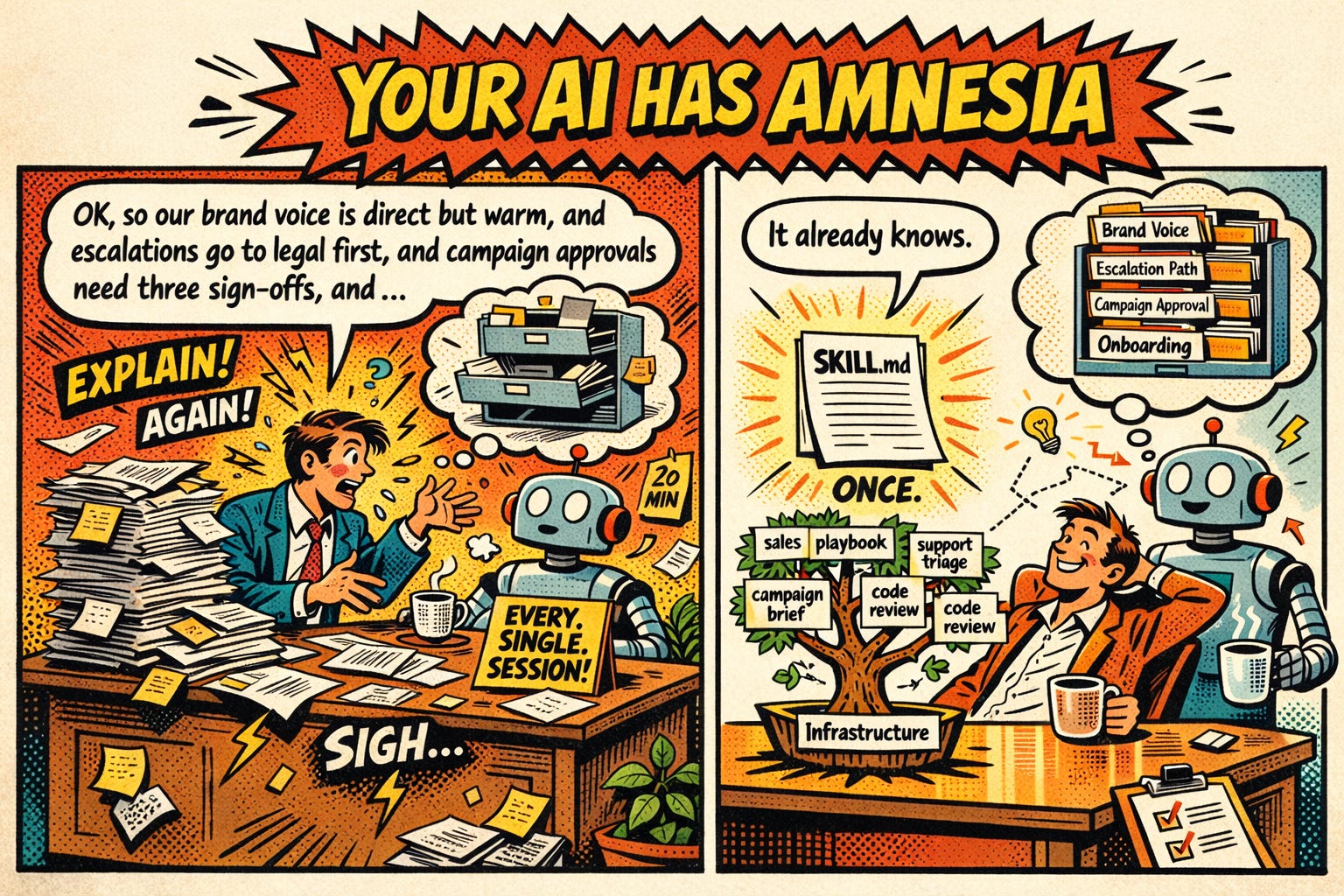
TL;DR: The most valuable thing you can build with AI isn’t code — it’s a library of markdown files that encode how your organization actually works. Models get smarter every quarter. Your institutional knowledge doesn’t ship with them. The companies that figure this out will compound their AI advantage. The ones that don’t will keep starting every session from scratch. Clone the LLM Coding Workflow Skill on GitHub.
Here’s an experiment.
Open Claude, ChatGPT, or Gemini — doesn’t matter which. Ask it to review a pull request for a codebase it’s never seen. Watch what happens.
It will give you a competent, generic review. It’ll flag obvious issues — unused imports, missing error handling, maybe a naming convention violation. It’ll sound smart. It’ll be polite.
It will also have no idea that your team uses TDD as a specification mechanism, that your commit discipline requires one logical unit per commit, that your codebase has a specific context budget because your developers burned through rate limits last month re-ingesting an 1,800-line log file on every append.
The model is intelligent. It’s also an amnesiac. Every session starts from zero. And the gap between “intelligent amnesiac” and “useful teammate” is not a smarter model.
It’s a skill.
The Skill, Defined
A skill — in the way Anthropic formalized it in October 2025 — is a markdown file with YAML frontmatter that tells an AI agent how to do something specific. It sits in the agent’s working directory. The agent reads it before starting work. It follows the instructions.
No Python. No deployment pipeline. No infrastructure team. Just structured markdown.
That sounds like a toy. I’ll come back to that.
The important thing is what a skill does: it transfers domain knowledge from a human’s head into a format that an AI agent can operationalize, session after session, without the human having to repeat themselves.
Nicolas Bustamante, who’s spent two years building Fintool — an AI agent for professional investors — put it bluntly: “The model is not the product. The skills are now the product.”
His DCF valuation skill tells the agent to research every segment, load industry-specific guidelines, build the model in Excel, calculate WACC using benchmarks, run sensitivity analysis, then validate the base year against actuals. Without that skill, frontier models will produce a DCF that looks right but misses stock-based compensation add-backs, uses wrong discount rates for the industry, and skips sensitivity analysis.
The model knows what a DCF is. It can explain the theory. But executing one in a way that a professional investor would trust? That requires encoded domain knowledge. A skill.
Translation: intelligence without context produces plausible nonsense. Intelligence with a skill produces work.
The Knowledge You Already Encoded (But Can’t See)
Here’s what’s interesting. Millions of people have already written skills. They just don’t know it.
If you’ve built a Custom GPT in ChatGPT, you’ve written a skill. The instructions you gave it — “You are a marketing strategist who focuses on B2B SaaS. Always suggest A/B test variants. Never recommend tactics without citing a case study” — that’s encoded domain knowledge in markdown. It tells the model who to be, what to prioritize, what to avoid.
Gemini GEMs, .cursorrules files, custom assistants in any platform — same thing.
The problem is where that knowledge lives.
It’s locked inside the platform. A Custom GPT’s instructions are invisible to everyone except the person who created it — and even they can’t easily export, version, or share them. A GEM’s encoded knowledge stays in Google’s walled garden. A .cursorrules file at least lives in your repo, but it’s scoped to one editor and one project.
The result: organizations are building pockets of AI expertise that are structurally invisible. The marketing lead has a Custom GPT that’s brilliant at campaign briefs — and nobody on the product team has ever seen the instructions. An engineer has a GEM that's excellent at code review for their specific stack, and it's trapped in their personal Google account. A financial analyst has a Claude project with carefully tuned instructions for earnings analysis, and when they leave the company, that knowledge walks out the door.
This is the same problem enterprises had with spreadsheets in the 1990s. Critical business logic, locked in individual files, on individual machines, maintained by individual people. The solution then was to move that logic into shared systems with version control, access management, and institutional ownership.
The solution now is to up-level that encoded knowledge — extract it from walled-garden UIs, make it visible, make it portable, make it organizational.
Skills are that mechanism.
What a Skill Actually Looks Like
Last month I published the AI-Augmented Coding Workflow Skill — a template based on best practices Addy Osmani shared in January, and I updated it again this past weekend. It’s a single markdown file — SKILL.md — that works for two audiences at once. At Logitech, we extended it with our own institutional context — model routing through our internal gateway, commit conventions, recovery playbooks specific to our infrastructure. The public version is the scaffold; the internal version is the scaffold plus domain knowledge. That layering is the point.
For developers, it’s a pre-flight checklist, in-flight operating manual, crash recovery playbook, and model selection guide. Four phases of an AI-assisted coding session, with copy-pasteable templates and prompt patterns.
For AI agents, it's a machine-readable operating manual. Drop it into your project directory and the agent reads it before writing a single line of code. It follows ten explicit principles: plan before coding, break work into small chunks, provide extensive context, choose the right model for the task, commit after every logical unit, customize AI behavior with rules files, embrace strong testing, and maintain human accountability throughout. The latest version adds two collaboration modes (interactive pair programming and autonomous delegation) so the same skill scales from quick fixes to multi-file feature work.
The skill exists because of the growing pains everyone hits with AI-assisted development. A developer’s work log hit 1,800 lines and the AI agent was re-reading the entire file on every append — a token bonfire. Another session died mid-task with no commits and no spec — an hour of reconstruction. An agent refactored files nobody asked it to touch because nothing told it to stay in scope.
These aren’t unique to any one team. They’re the delegation learning curve — the same dynamic you see when you hand a smart intern a vague brief and walk away. The fix is the same: not a smarter intern. A better brief. A skill.
Within a day of shipping the first version internally, a senior developer had submitted feedback. His contributions made the skill better: softer TDD language for experienced developers, testability guidance instead of arbitrary line-count limits. That’s the compound effect: one file, improving through use, encoding the team’s collective knowledge about how AI-assisted development should work.
No deployment pipeline to start. No code review cycle. A markdown file and a changelog entry that credits the contributor. At scale, you'll eventually want lightweight distribution (e.g. versioned bundles, a shared registry) but the entry point is still a text file, not a software project.
Why Skills Beat Code
Bustamante makes the architectural argument clearly. Skills are better than code because:
Non-engineers can create them. His financial analysts write skills. Our developers contribute to them. A portfolio manager who’s done 500 DCF valuations can encode their methodology without writing Python. A senior developer who disagrees with a TDD stance can submit a revision without opening a pull request.
No deployment is needed. Change a skill file and it takes effect on the next session. No CI/CD, no release cycle, no waiting. Domain experts iterate on their own timeline.
They’re readable and auditable. When something goes wrong, you can read the skill and understand exactly what the agent was supposed to do. Try doing that with a 2,000-line Python module.
They’re deletable. This is the underrated advantage. If the model gets smart enough to not need a skill, you delete a markdown file. No deprecation cycle, no code to decommission, no migration. If the model still needs it, the skill compounds in value every session. The asymmetry favors writing more of them.
A word on boundaries. Skills are readable, which means they’re also reviewable — and they should be! A skill that encodes “always use this API key” or “here’s the customer list” is a liability, not an asset. The same way you wouldn’t put credentials in a README, you don’t put sensitive data in a skill. Skills encode methodology, not secrets. Access control, review cycles, and clear ownership matter here just as they do with any institutional document. The difference is that skills are simple enough that a compliance team can actually read them (try saying that about your Python modules).
But there’s a deeper reason skills beat code, and it’s the one most people miss.
Skills are how you delegate to AI the way you’d delegate to a human.
Think about what happens when you onboard a new team member. You don’t rewrite your codebase. You don’t change your architecture. You hand them documentation: here’s how we do things, here are the standards, here’s what to prioritize, here’s what to avoid. You transfer context. You encode institutional knowledge into a format they can absorb and operationalize.
Skills are that onboarding document — except the “new team member” spawns infinite instances of itself, starts every session from scratch, and needs the brief every single time.
That’s not automation. That’s delegation. And the companies that get good at it will have a structural advantage that model improvements can’t commoditize.
The Model Will Eat Some Skills — But Not the Ones That Matter
Bustamante predicts that in two years, most basic skills will be one-liners. “Generate a 20-tab DCF.” The model will know what that means.
He’s probably right — for procedural knowledge. How to format a spreadsheet. How to structure a valuation. How to write a press release. These are patterns the model can learn from training data. As models improve, the step-by-step scaffolding becomes unnecessary.
But there’s an entire category of knowledge that models will never learn from training data, because it doesn’t exist in training data.
Your brand voice guidelines — the specific way your company talks to customers, the words you never use, the tone shifts between channels. Your sales team’s qualification criteria and the deal stages that actually predict close rates. Your support escalation paths — which issues go to engineering, which go to legal, which get a templated response. Your HR onboarding sequence and the compliance steps that vary by jurisdiction. Your marketing team’s campaign approval workflow and the three people who need to sign off before anything goes live. Which models are available through your internal gateway and what they cost. What “done” looks like in your context.
These are the skills that survive model improvement. They’re context-heavy, organization-specific, encoding decisions that live outside the model’s training data. The model gets smarter at reasoning; it doesn’t get smarter at knowing your organization.
The implication: the skills that matter most are not the ones that teach the model how to do generic tasks. They’re the ones that teach the model how to operate as a member of your team.
The Skills Race
The model race dominated 2024 and 2025. Who has the highest benchmark score. Who has the largest context window. Who can reason the longest.
That race still matters, but it’s converging. Frontier models are close enough in capability that the differentiator is no longer which model you use. It’s what you put around it.
If Bustamante is right that skills are the product, and if Anthropic’s formalization of Agent Skills signals where the platform is heading, then the strategic question for every organization isn’t “which model should we deploy?”
It’s “what skills should we write next?”
The natural candidates for any organization are wherever you have strong internal methodology that people keep re-explaining to AI agents every session. Code review standards. Testing frameworks. Deployment checklists. Architecture decision records. Incident response. Campaign brief templates. Competitive analysis frameworks.
Each one is a SKILL.md waiting to be written. Each one compounds: the skill gets better through use, contributors improve it, the agent gets more effective with every revision.
And here’s the unlock that should get every enterprise AI leader’s attention: this isn’t a technology project. It’s a knowledge management project. The people who should be writing skills aren’t your engineers — they’re your domain experts. The analysts, the PMs, the operators who have done the work a thousand times and know exactly how it should be done.
They’ve always had this knowledge. They’ve just never had a format that made it operational at machine scale.
Now they do. A markdown file.
The Tree and Its Branches
Think of your organization’s AI capability as a tree. The trunk is infrastructure — model gateway, authentication, sandboxes, monitoring. Engineering work. Table stakes.
The branches are your skills. Each one extends reach into a new domain: coding workflows, financial analysis, marketing campaigns, customer support, supply chain planning. Every branch encodes institutional knowledge that makes the agent more effective. And like real branches, they need pruning: skills cluster into natural domains, and those domains need explicit boundaries. A personal assistant skill and a coding methodology skill don't belong on the same branch — one is portable, the other is private. That separation is an organizational design decision, not a technical one.
The leaves are individual sessions — the actual work getting done. Better branches, more productive leaves.
Most organizations are pouring energy into the trunk. Better infrastructure, more models, faster inference. That matters. But the ROI is in the branches. And the branches are markdown files your domain experts can write today.
The Custom GPTs and GEMs your people have already built? Those are branches trying to grow inside walled gardens where nobody else can see them, version them, or build on them. Extract that knowledge. Make it portable. Make it institutional.
The model race produced the trunk. The skills race grows the tree.
What to Do Tomorrow Morning
Audit your invisible skills. How many Custom GPTs, GEMs, custom assistants, and
.cursorrulesfiles exist across your organization? That's encoded knowledge you don't own. Start extracting it, and as you do, notice which teams they cluster around. The audit isn't just "find the skills." It's "find the skills and figure out who should own them."Pick your first skill. Find the workflow where your people keep re-explaining the same context to AI agents every session. Write a
SKILL.mdfor it. It doesn’t have to be perfect. Ship it. Iterate.Make contribution easy. The skill should improve through use. Create a visible feedback channel — a Slack channel, a shared folder, a repo — and credit every contributor. Pull, not mandates.
Think in branches. Every team has domain expertise that would make an AI agent dramatically more effective if it were encoded as a skill. The question isn’t whether to write skills. It’s which ones to write first.
The model is getting smarter every quarter. Your institutional knowledge isn’t getting any more accessible. The distance between what the model can do and what it knows about you = where the ROI lives.
Close it with a markdown file.
Grow your branches:
Nicolas Bustamante, “Lessons from Building AI Agents for Financial Services” — the Fintool case study, including detailed architecture for skills, sandboxing, and filesystem-first agents (January 2026)
Anthropic, “Equipping Agents for the Real World with Agent Skills” — the formal Agent Skills specification (October 2025)
Nicolas Bustamante, “The RAG Obituary” — the case for agentic search over embedding pipelines
Addy Osmani, “How to Write a Good Spec for AI Agents” — the methodology behind the coding workflow skill (January 2026)
Braintrust, “Testing if Bash Is All You Need” — eval comparing SQL, bash, and hybrid agent architectures
Me, AI-Augmented Coding Workflow Skill — open-source skill template. Clone it, extend it, make it yours.
The model race produced the trunk. The skills race grows the tree. Your best domain experts have been encoding knowledge into walled gardens for two years. Give them a markdown file and get out of the way.
This is one of the sharpest framings I've seen on where AI value actually lives. The tree metaphor is excellent — and Bustamante's line that skills are the product, not the model, matches exactly what I'm experiencing operationally.
One thing I keep bumping into: skills make individual sessions dramatically better, but sessions still start from scratch. The branches don't know about each other. I've been building a governance layer underneath my skills — status files that carry state forward, decision logs that persist choices across sessions — and that's where the compounding actually kicks in.
Your audit recommendation is the right first move. I'd just add one follow-up question after "which skills should we write next?" — what sits between the skills?
Very interesting!