

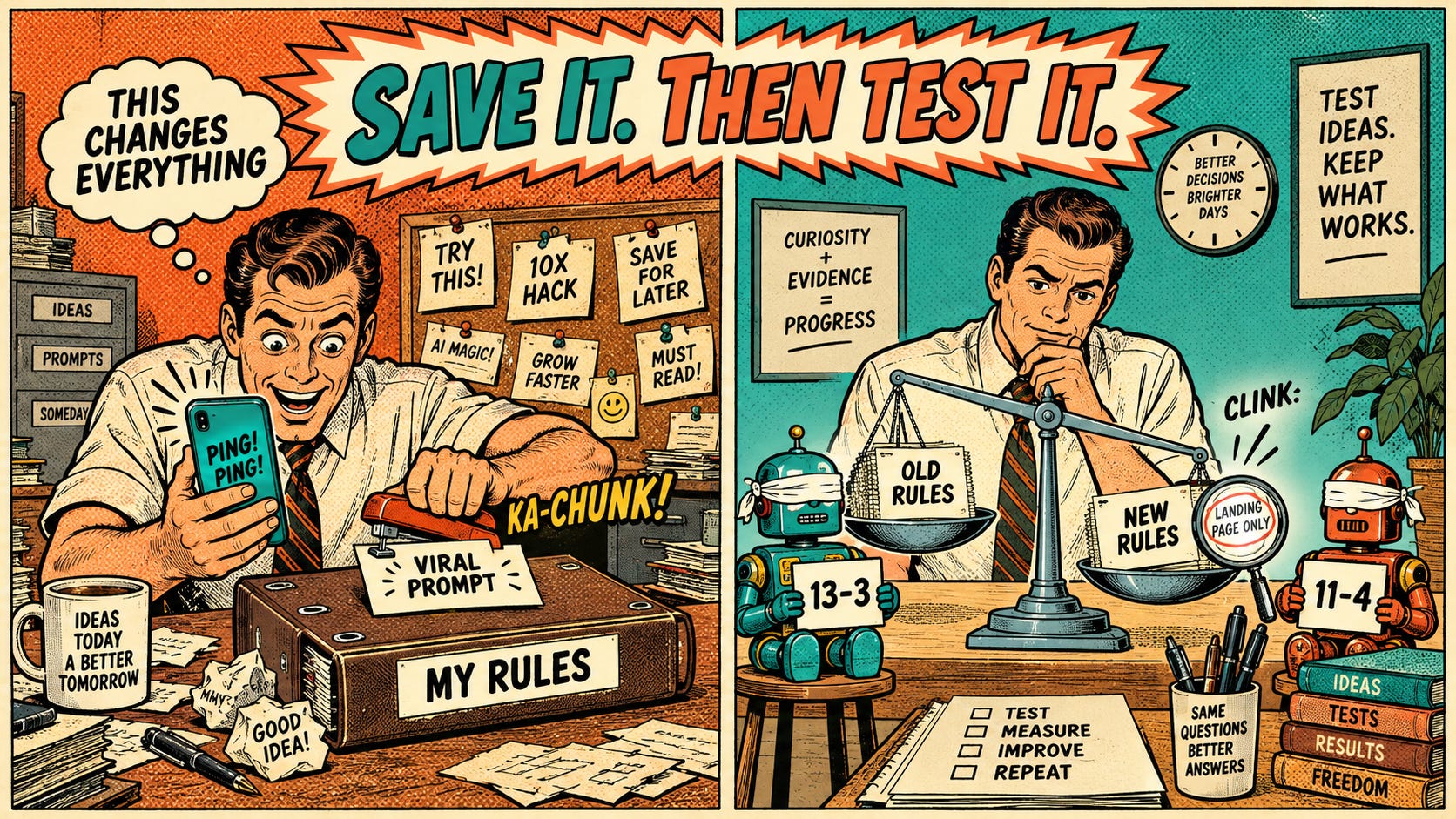
TL;DR: Felix Rieseberg’s “deeper, not bigger” prompt reached me Thursday morning as a screenshot of a LinkedIn post that said “save this prompt and try it.” Instead, I turned three of its ideas into rule changes and tested them blind against my current working rules: 16 agent runs, two judges from two different labs. The new rules won 13–3 and 11–4. I shipped two changes, held one, and found a bug in the winner that only showed up because the old rules beat it on one task.
Yesterday morning, someone dropped a screenshot into Agentic Tribe, one of the WhatsApp groups where practitioners trade what they’re trying. It was a LinkedIn post from a page called Evolving AI: “One of the lead engineers working on Claude just shared a prompt that could change how you use AI.” Then the prompt, in full:
“I want a deeper version of this task, not a bigger one. Before rewriting it: (1) say what a top professional in this field would do here that I’m not asking for; (2) name the rawest material they would start from instead of what has already been digested for me; (3) name the specific methods and tools they would use; (4) say what, other than you or me, would show the result is right. Then rewrite my prompt to ask for exactly that.”
Then the call to action: save this prompt and try it next time.
It’s a good prompt. I didn’t try it.
That’s where my best tips come from: groups like Agentic Tribe, AI Junto, and AI Prompts, where people post what broke along with what worked. A tip from someone I trust still doesn’t go in on arrival. My working rules are a 4,000-word CLAUDE.md file and a delegation skill, and every line in them was earned by a failure. A tip that works for the person who wrote it may not work for me. The only way to find out is to measure it, so that’s what I did.
What we did. Two of Felix’s four questions were already in my rules: the methods question is planning the model does on its own, and “what would show the result is right” is a standing rule called Verify Before Deliver. The other ideas became three candidate changes:
Start from the system of record (the filing, the regulation text, the vendor’s own table), not a digest of it.
Every definition of done needs one check that something other than the author or me can run.
Before starting, the agent proposes what a top practitioner would add that I didn’t ask for.
Then the test. Sixteen Claude Opus 5.5 agents worked four real tasks: pick a default model for our AI gateway, list what the EU AI Act requires of an internal chatbot, summarize what Logitech has told investors about AI (using public sources), and write a delegation brief for migrating a Google Gem to a skill. Half ran on my current rules, half on the new ones, two runs each. I paired every output against its rival, shuffled the order, and stripped the labels. Claude Fable 5.1 judged with web access and spot-checked facts. GPT-6 Astra judged through the buddy system I built in September. The average length came out at 685 words versus 695, so the winner didn’t win by writing more.
What we learned
The new rules won 13–3 with Fable and 11–4, with one tie, with Astra. On the investor brief, the winners quoted the 10-K. The losers quoted MarketBeat.
The old rules won on one task, and that loss taught me more than the wins. On the EU AI Act task, the new-rules agents read the regulation itself and stopped there. They missed the European Commission’s July 20 guidelines on Article 50, the document that says how the transparency duties apply to a chatbot only employees use. One agent wrote, “I read only the landing page.” An old-rules agent found the guidelines through law-firm summaries and changed its advice because of them.
My rule had turned “primary source” into “the one document.” The fix went in the same day. Guidance and amendments count as the system of record, and when an agent can’t read the primary in full, it uses the summary’s substance with a label instead of dropping it. On the rerun, one of two agents read the guidelines end to end and cited page numbers.
The judges also disagreed on six of 16 pairs. Astra ran without web access and called the guidelines-based advice unsupported. It couldn’t check, so it guessed from what it knew. Felix has a line for this in his original post that the repost cut: “Ideally that’s a tool the model can run to get feedback immediately.” A judge without tools is just an opinion.
Then I caught myself. My first take on all this came from the screenshot: a WhatsApp image of a LinkedIn repost of a blog post, three hops from the source.
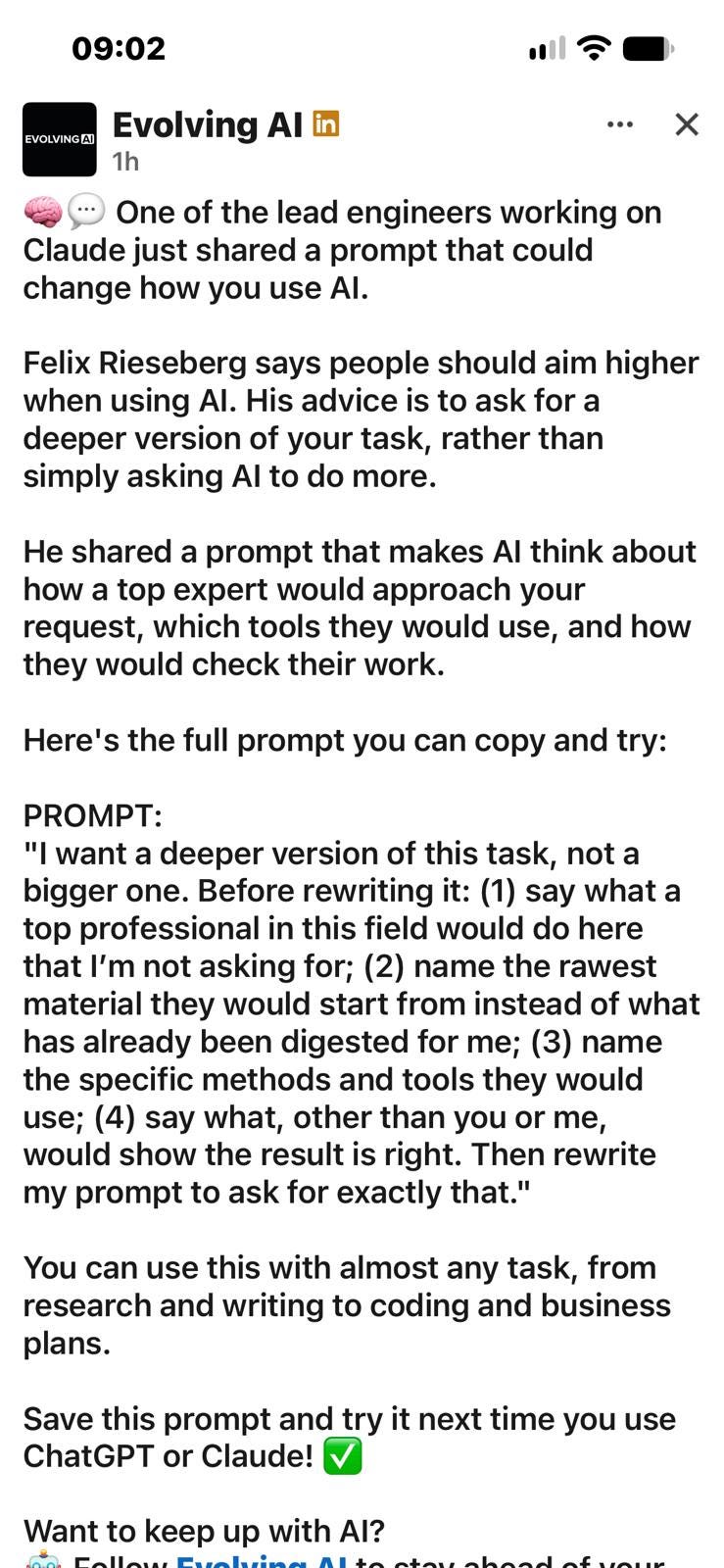
I was arguing for the rawest material while reading a digest of a digest. So I went back, first to the LinkedIn post and then to the original. Felix’s original post lays out four kinds of ambition, and it describes him as an engineering manager at Anthropic, not “one of the lead engineers.” It also carries a sentence the repost left out: “Do not ask the model to judge itself.”
What we changed
The system-of-record rule, with the fix, now sits in CLAUDE.md, a guide I’ve updated more times than the Screen Time passcode I keep rotating for one precocious tween. The checkable definition of done now sits in my delegation skill. Fable picked the stronger delegation brief 4–0, every time on that criterion, because the winning briefs named a blind test set and a pass threshold instead of “Eric approves it.”
What we didn’t
I held the practitioner-additions interview. The delegation-brief task tested it and change 2 together, so its effect can’t be separated out. Astra also flagged briefs that claimed gaps in a Gem they had never seen. I also skipped the prompt’s last step, “rewrite my prompt.” In my setup, that costs a turn and hands me homework when I wanted work.
Translation: a tip is a hypothesis with good distribution. Run it before you adopt it.
What to do this weekend
Pick the one tip you saved and haven’t tested. Write down what it should change in your output before you run it.
Run old and new on the same three tasks. Strip the labels and shuffle the order before anyone judges.
Use a judge from a different lab, and give it tools. A judge that can’t check facts will grade on vibes.
The post said save the prompt and try it next time. Save it. Then make it beat what you already have.
Evals (aka Receipts)
How to be more ambitious: A tutorial for humans with models, Felix Rieseberg, October 13, 2026. The original post and the full prompt.
Evolving AI, LinkedIn post, October 15, 2026. The repost, which reached me as a screenshot shared in Agentic Tribe.
Guidelines on the transparency obligations for providers and deployers of AI systems, European Commission, July 20, 2026. The document the new rules missed.
I Built a Buddy System for Claude and ChatGPT, Beyond Reason, October 1, 2026. How Astra got a seat on the panel.
Tested, judged, half-shipped. Tips need evals too.