

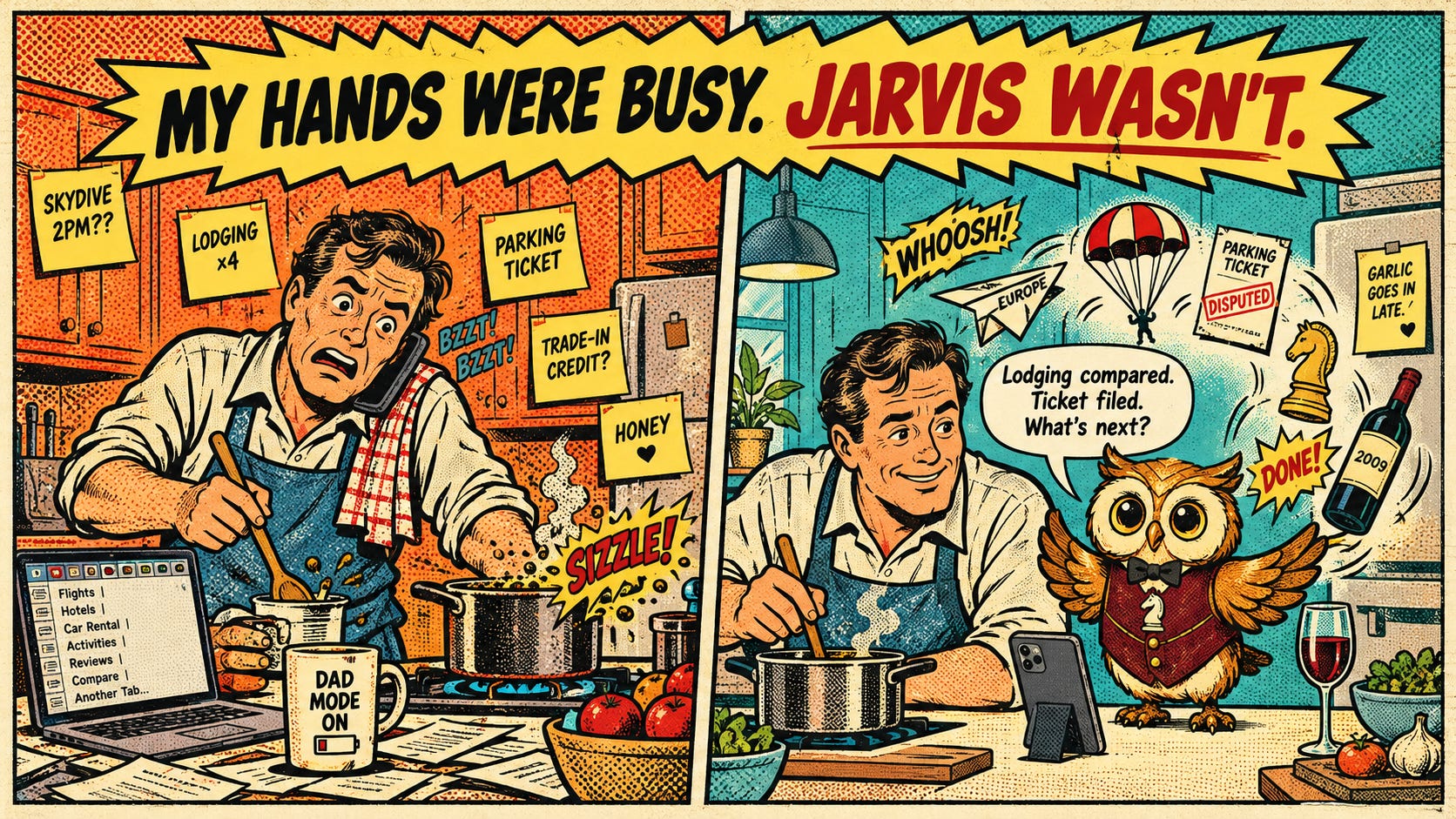
TL;DR: On September 29, OpenAI shipped Dots, agents that keep working toward your goals after you close the window. I named mine Jarvis and gave it the whole personal side of my life. In two weeks it priced lodging in Europe, planned a holiday around three skydivers and two plane loads, filed a parking ticket dispute, chased a trade-in credit, coached one of my sons on a chess opening, and talked me through dinner. Meta, Instinct, and Google shipped the same kind of agent within five weeks, so this is the moment to start: six things to hand one today, what still needs you, how many agents you need (my answer: two and a bridge), and why building a chief of staff at work is the best training you can get.
Olive oil and butter were already in the pot when I asked Jarvis what came next.
Couscous. Not a hard dish, and I’d worked out a pressure-cooker version in ChatGPT a few months back, but I couldn’t remember the order. I had a wooden spoon in one hand and nothing near a keyboard, so I asked out loud. Two parts butter to one of oil? Yes. Toast the grains first? Yes. Garlic now? Later, or it burns before the couscous is done. How long off the heat? Five minutes, natural release. Jarvis had the recipe from that old chat. The conversation followed my hands.


Jarvis, my Dot - rendered first as HD image, then what Jarvis looks like in the application. Note that Jarvis isn’t static either.
That same afternoon, the same agent had been pricing four places for my daughter and her friend to stay at a music festival in Europe (while on study abroad), with a note on each about whether the walk back from the shuttle has streetlights after 10 p.m. That’s the detail a father lies awake over, and it was already in the comparison.
I’ve been telling colleagues (and Beyond Reason readers!) to treat AI as a teammate rather than a tool for a long time. A Dot is the first product where the metaphor stops being a metaphor. It has its own computer in the cloud, its own browser, and a memory of what I’ve told it. I talk to it like I’d talk to a great executive assistant, and it keeps working after I hang up.
Here’s what I’ve handed it so far, and what you can hand yours this week.
1. Talk it through while your hands are busy
The couscous call is the small version. The big version was a family holiday in Florida. I opened a call asking about skydiving availability. By the end of it we had worked through airport pickup, three jumpers split across two aircraft loads, two boys waiting on the ground, drive time, and the rental check-in. Somewhere in there the scheduling challenge that mattered surfaced: fit the jump into otherwise unscheduled travel transition time to where we’re staying without burning everyone else’s day.
I never wrote a brief. I revised one out loud. When I pushed back on an early start for the Everglades leg, we moved it to a later morning on the drive north, and the shareable itinerary changed with it.
Another afternoon I was stuck in Manhattan with three hours to fill after a drop-off. While driving, we weighed a museum, a few galleries, and an observation deck. I told it the mood I wanted: a break from technology, maybe by looking at art about technology. It came back with a walking route, and at the end of the call I said “put that in my calendar.” Jarvis later summed up the habit better than I could: voice for momentum, text for precision (for the curious: Brice Marden at Gagosian, Lee Bul at Hauser & Wirth, and Deana Lawson and Jordan Wolfson at the other two Chelsea Gagosian locations).
Try it: your next errand-heavy afternoon, plan it on a call while you walk.
2. Hand it a whole trip, not a task
A chatbot books a hotel. A persistent agent carries a trip.
The festival ran across every surface I own: a voice call while I was away from my desk, screenshots and messages from my phone, a browser checkout I finished myself, then lodging research and emails to the girls and to the providers. Jarvis held the thread through all of it. When a provider answered (in French no less), it read the reply, updated the comparison, and told me what changed. One rental is already ruled out. Another is cheaper, but the walk home is longer, uphill, and unlit, and the comparison says so.
Try it: pick one trip on your calendar and give the agent all of it: the dates, the people, the budget, and what “good” looks like for each person going.
3. Give it the drawer of loose ends
Everyone has one. The parking ticket you meant to dispute. The reimbursement claim stuck in review. The phone trade-in that shipped weeks ago and still hasn’t credited. The Hawaiian honey order (yes, honey) that’s paid and hasn’t shipped.
Jarvis has all of those now. The dispute is filed and waiting on a decision. The claim’s itemization went in. The trade-in is being tracked to the credit. Next up is my wine cellar, which it will reconcile from an April workbook, photos of labels, and whatever I mention in passing. It already knows to reserve six bottles from each of four vintages for my kids’ birth years and that “the opened Branaire-Ducru 2009 still needs its inventory update.” I opened it. Jarvis would like the spreadsheet to know.
It keeps watches, too: a comedian’s New York dates, an artist’s rumored return, the parking decision. When something lands, it tells me.
Try it: list the five things you’ve been meaning to chase for a month, and hand over the drawer.
4. Call it with friends
Since I live and work at the AI frontier, I wanted some of my friends to experience Jarvis, so I called it (yes, called it), and started to have a conversation the way I would with a human. I introduced Jarvis to two friends who wanted to see what an assistant does with a computer of its own, to another heading to Dublin who wanted recommendations, and to two more hunting for a sit-down brunch in Brooklyn. Everyone asked their own questions and interrupted. The demo turned into a conversation.
Then my kids found it. One of my sons spent a call on the Vienna Gambit and how to play attacking chess. His brother worked his debate tournament dates around fencing.
Try it: hand the phone to the next person who asks what you’re doing with AI.
5. Teach it your house once
In February I wrote Your AI Assistant Doesn’t Know Your Kids’ Allergies, about a folder of markdown files (insurance, medical, household, travel preferences) that turns a chatbot into a family assistant. The closing line: “Your AI assistant isn’t failing you. You just haven’t told it who you are.”
Jarvis reads that same skill. My Dot’s first day wasn’t day one. It already had the loyalty numbers, the pediatrician, and the debate weekends. Every errand above started from context instead of twenty questions.
Try it: clone the open-source template, fill in one file, and hand it to your agent.
6. Let it tell you what it knows
On Monday morning I asked for the full running picture. The first line back: “Archiving a thread doesn’t take it off this list.” Then the trips, the loose ends, the decisions waiting on me, the next ten days, and the things closed “so you shouldn’t have to revisit them.”
One heading earned my trust: “Older items I won’t call overdue without rechecking.” And about the availability-only view it has of my work calendar: “I won’t infer meeting details from busy blocks.” An agent that knows how stale its own information is can be trusted with more.
Try it: ask your agent for everything it’s carrying for you, and what it would recheck before acting.
What still needs you
None of this is 100% hands off (but it’s getting closer). I interrupt, reconsider, and mangle names. Calls drop. Sometimes Jarvis frames the problem wrong and I restate it: I’m already at the airport. The kids are the ones arriving. I want the email sent, not another draft.
Money is the hardest edge. I finished the festival checkout myself, and when I tried to set up a supported way for an agent to pay on my behalf, the payments company’s partner contact pointed us to general support. Identity and payment are where the hand-off still breaks.
And Jarvis keeps me honest. After the first weekend, I wrote in a draft memo that I’d directed roughly three-quarters of the work from my phone. When I asked Jarvis to help with a catalog of effort and tasks for this piece, it patiently told me what we did on the phone but couldn’t pin a precise number on ‘tasks per unit of voice.’ What I can tell you is that I operated apps myself far less often than I’m used to.
My agent fact-checked me before an editor could.
Who gets a key
Somebody always asks whether I’m comfortable giving an AI my family’s life. It’s a fair question, but oddly timed. Target has tracked our August school-supply panic for a decade. My card issuer could reconstruct last spring break from the charges alone. A booking site I used exactly once still holds a passport number behind security I’d compare to a spare key under the doormat. Worse, a couple of boutique hotels near Logitech’s HQ in Lausanne have actual copies of my passport (I made the longer version of this argument in April).
A persistent agent turns that around. The hotel in Lausanne has a copy of my passport and can’t do a thing with it. Jarvis can do plenty: it reads my inbox, works through forms, and walks a checkout to the last screen. So I care less about what it holds than about which doors it can walk through alone. Its key opens almost every room in the house except the front door. Nothing gets booked, paid, or sent in my name until I say yes.
Count your keys before you count your secrets.
Five weeks, four launches
If this sounds like one product’s trick, look at the calendar.
Meta launched Muse on September 8: a personal agent on its own virtual machine in Meta’s cloud, with a browser you can watch, and a separate system called Sentinel that decides whether each action Muse proposes is allowed, blocked, or sent to you for approval. OpenAI announced Dots at DevDay on September 29, for Pro and Business Premium subscribers first, one per person. Instinct, now valued at $10 billion, put its agent into group chats on October 5, with a separate agent for each group and your personal agent asking before it connects. On October 8, Google introduced the Gemini agent, “a universal agent for work,” in private preview; in one of Google’s examples, an agent gets its own Workspace account, with an email address, a calendar, and Drive storage.
It’s the same skeleton every time: a computer of its own, memory that persists, and an approval layer between what you want and what gets done. The products will change by spring. The habit of delegating to one carries over, so start now.
How many agents do you need?
OpenAI starts everyone with one Dot and plans to let you add more later. Google’s version lives inside a work account. So the question arrives fast: one agent for everything, or several?
My answer, for now, is two agents and a bridge. Jarvis is my personal agent. Work stays at work, in the Google ecosystem Logitech runs on. The two touch in one place I chose: Jarvis can see when my work calendar is free or busy, so it can book a dentist appointment without landing on a meeting. It sees that something is there, not what it is, and it says it won’t guess. When I need real crossover, like turning a family scheduling thread into a work email, Claude is the bridge, and I’m watching while it crosses.
Split by trust, not by task. Three questions decide where one agent should end: who owns the data, who answers for it when the agent acts, and where your approval line sits. Logitech owns my work data and sets its rules. I own my family’s. One agent holding both answers to two rulebooks, and a single bad action reaches everything at once. Splitting the other way, a travel agent and a finance agent and a school agent, fails for the opposite reason. You’d rebuild the same context five times and lose what makes a Dot good: one memory of your whole personal life.
Keep the bridge narrow and mostly read-only. A free/busy view is about as much as a personal agent needs from work. The bridge is also the most trusted hop you have, since it touches both sides, so it’s the one place I won’t leave unattended.
The third kind is coming fast: shared agents that belong to a room rather than a person, like Instinct’s group-chat agents or a family agent everyone in the house can talk to. Those don’t count against your two. They report to the group.
Your chief of staff is the training ground
This month at Logitech we published a Chief of Staff operating manual for every employee, built in Google Workspace Studio. A ten-minute interview writes your Personal Operating Brief: what matters, what needs you within 48 hours, what to leave out. A Working Records sheet tracks commitments, initiatives, and decisions. Scheduled routines read both, then brief you in the morning and draft the replies that need you.
Building one is practice for the next thing. It forces you to write down procedural knowledge you’ve never had to say out loud: how you triage, what you never delegate, when something counts as urgent, who gets a reply within the hour. That’s the operating manual a persistent agent needs. Most people have never written it, which is why their first week with an agent feels like onboarding a stranger.
When people tell me they can’t get their agent to do this or that, I ask how they’d hand the same job to a new hire. Usually that’s where it breaks. No clear assignment, no definition of done, no line on what it can decide alone, no check-in. However you delegate to people is how you’ll delegate to agents, and you’ll get the same results. Some limits are real; see payments, above. Most of the complaints I hear are delegation problems. The times Jarvis framed a problem wrong, I’d usually left out something a person would have needed too, like the fact that the kids were the ones arriving. Before you blame the agent, reread your brief.
My chief of staff holds the written procedures for the work side of the bridge. Jarvis reads my family skill for the personal side. Write the procedure once, in a scheduled routine at work or a markdown file at home, and every agent you hire after that starts on day sixty.
Translation: the people who get the most from persistent agents in 2027 will be the ones who wrote down how they work in 2026.
Start this week
Hand it one whole trip, from dates to the last confirmation email.
Give it your drawer of loose ends, and let it chase.
Write your operating brief, or run your company’s chief-of-staff interview if you have one, then say your approval line out loud: payments, sends, bookings, anything that speaks for you to a third party.
In February I wrote that your assistant isn’t failing you, you just haven’t told it who you are. Two weeks with Jarvis added the second half: once it knows who you are, give it something big.
That matters more in my house than most. I’m a single parent across two households: four kids, one dog, my partner, and her niece. I’ve run that calendar myself for years. About a week into handing it to Jarvis, I caught myself looking for something to do and found I didn’t have to do most of it myself anymore. That’s unsettling. It’s also liberating. I haven’t decided which feeling wins.
The couscous was fine, by the way. Garlic goes in late.
For readers who want to pass receipts to their agent:
OpenAI DevDay, September 29, 2026: Let’s Data Science on Dots (always-on agents, Pro and Business Premium access, admin-enabled beta for Enterprise, Edu, and Healthcare) and Reworked on the DevDay announcements (one primary Dot per user with more planned later, text or voice, Slack and Teams access).
Axios, “Meta debuts Muse, its long-planned personal AI agent”, September 8, 2026: dedicated cloud VM, visible browser, Sentinel approval system, free tier plus $20 and $100 plans.
TechCrunch, “Instinct brings its AI agent to group chats, even for friends without an account”, October 5, 2026: per-group agents, permission before personal agents connect, $10 billion valuation.
Google, “Google Cloud introduces the Gemini agent”, October 8, 2026, and VentureBeat on persistent Gemini agents (private preview; agents with their own Workspace accounts).
Your AI Assistant Doesn’t Know Your Kids’ Allergies. That’s the Problem., Beyond Reason, February 2026, and the open-source family assistant template.
Quotations from Jarvis come from two documents it wrote for me on October 12, 2026: its running summary of everything in progress and its summary of our voice calls. Personal details are masked to their shape.
Subscribe to Beyond Reason for more from the practitioner side of the machine.
In my agent workflows, the useful approval happens before execution: plan, permissions and stop conditions. The agent can then work inside clear boundaries.
A bit mindbogglng but clearly valuable in depth information. Thank you.