

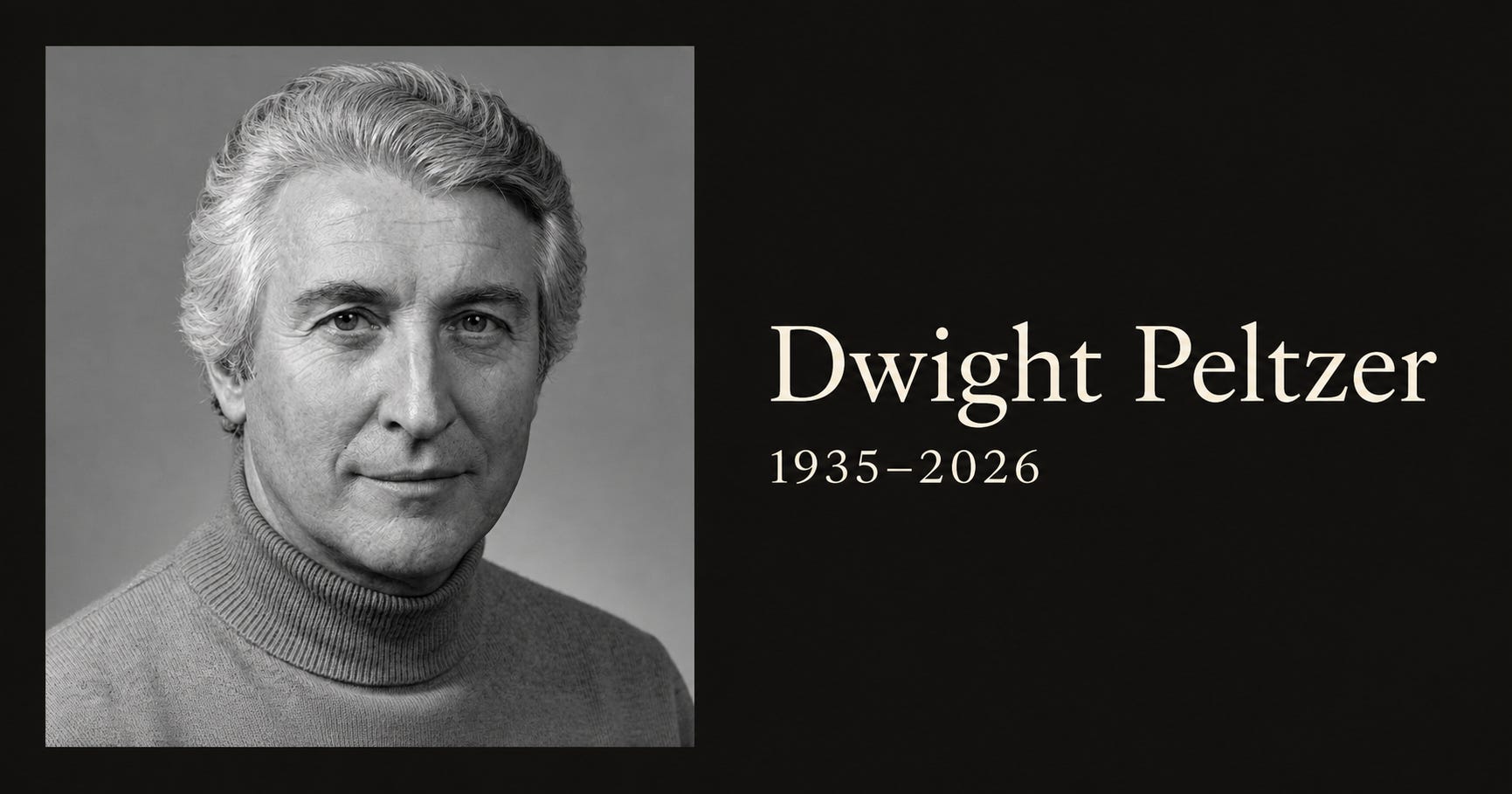
TL;DR: Dwight Peltzer’s living history brings together his career and more than seven hours of recovered performances. Building it took archival research, AI, and help from the people who knew him.
Dwight Peltzer died on September 2, 2026, at ninety. He had been my piano teacher since 1988, a close friend, and a father figure to me.
Growing up on Long Island, I spent Saturdays going into the city with my mom for lessons at Turtle Bay Music School. When my teacher, Elise, left the school to teach outside the city, I couldn’t continue with her. My mom’s boyfriend at the time, Stephen, had sung with Marla, Dwight’s wife, and knew we were looking for a teacher. That connection brought me to Dwight’s home for an audition.
I thought I was a pretty good pianist. I knew Scott Joplin’s Maple Leaf Rag cold and played it for him with my eyes closed. I didn’t really understand whose company I was in, although the Bösendorfer should have been a clue. He said that was pretty good, then asked me to play some major scales with both hands: C-sharp, F-sharp, B. I fumbled them. I was used to sitting down with a piece of music and hacking my way through it. The fundamentals hadn’t received quite the same attention as my eyes-closed Joplin.
I recognize that lesson in my ninjutsu training, and in most great pursuits in life: when you’re lost, go back to the basics. Dwight started teaching me that before I’d even become his student.
He gave me solutions to passages I still cannot play cleanly, one lesson at a time. Focal dystonia ended his professional concert career, but he never treated teaching as the consolation prize. Over thirty-eight years, I became his friend and collaborator as well as his student. This summer, we worked on preserving his life in music.
When I began looking for that life online, I found a Discogs page, three albums on streaming, and a library newsletter. There was much more, scattered across archives that rarely pointed to one another.
Dwight played Boulez’s First Sonata for Boulez, who wrote back. Salvatore Martirano wrote Cocktail Music for Dwight; he gave its world premiere in Berkeley in 1963 and kept performing it for sixteen years. Seiji Ozawa and the Boston Symphony engaged him for Donald Martino’s Piano Concerto in April 1980. The Boston Globe, in a review quoted in the family’s obituary, called him “among the best new music pianists of the day because he is one of the best pianists, period.”
He had studied with Edwin Fischer in Switzerland and Karl Richter in Germany on consecutive Fulbrights. Much of the work survived in program books, newspaper columns, and tapes that nobody could search by typing his name.
Recovering it became the work of the summer. AI helped me search far more material than I could have read on my own.
Reading the newspapers
Newspapers.com returned 1,062 pages for the exact phrase “Dwight Peltzer.” Eleven agents, working in two parallel sweeps, read 500 of them, each writing a structured record with a quotation to its own file as it went. The rest remain indexed and unread. Those raw records are kept intact; the site’s summaries can be rebuilt from them. Those searches gave us 510 records, 147 distinct performances, and 80 contemporary reviews. They’re in a public spreadsheet anyone can check.
One of the earliest performances we found was a Brainerd, Minnesota church notice from December 1940. He was five, playing “Merry Christmas.”
The Boston Symphony’s program book said Arthur Fiedler first put him on stage in San Francisco in 1961. The newspaper reports put it at August 11, 1962, playing Bartók’s Third Concerto. Fiedler invited him back the next summer.
The University of Illinois’s printed programs, digitized on HathiTrust, gave us the date of the world premiere of Robert Erickson’s concerto: March 9, 1963, with Dwight at the piano and Jack McKenzie conducting. In the New York Philharmonic Archives, we found six letters naming him in Boulez’s correspondence. One bears Boulez’s signature; another, in Dwight’s own hand, describes playing the sonata for its composer.
The New York Times radio listings helped reconstruct his appearances on WQXR’s Artists in Concert. One broadcast with clarinetist Jerome Bunke is named in print. A surviving solo recital is harder to date: the announcer’s previews suggest May 3, 1976, but we haven’t confirmed that date, and the site says so.
Then there were the tapes. Eighteen archival recordings had been recovered from analog sources. The WQXR reel ran about three percent fast, a quarter-tone sharp. Its four tracks were speed-corrected together, restoring pitch and tempo without compressing or limiting the dynamics.
Four faculty recitals from 1969–70 came from the original WFCR reels at UMass Amherst, transferred this year by Jeremy Smith of Special Collections. Seven hours and five minutes now stream from the page.
The Bach, with Marla’s help
Three orphan files were labeled “Bach, E minor.” Three movements of something for piano, with no identification we could trust.
Audio fingerprinting matched the loose files to recordings on the archive discs. Analysis suggested a possible orchestra. That still didn’t tell us what the piece was. There is no E-minor keyboard concerto in the standard J. S. Bach catalogue, which should have made us more suspicious of our starting assumption.
I listened to the second movement and heard strings under the piano, then checked the first and third. I could hear an orchestra in all three. I asked Marla for help, too.
The answer was Wilhelm Friedemann Bach, the eldest son: Keyboard Concerto in E minor, F. 43. A CBC listing in the Ottawa Citizen of August 12, 1964, backed up the identification. “W. F. Bach” had been there in print, waiting for us to know what to look for.
Marla’s voice is in the archive, too. The Debussy on the November 1, 1970 tape turned out to be the song cycle Fêtes galantes. She sings it, as well as Berg’s Seven Early Songs, with Dwight at the piano. Married for fifty-seven years, and there they are on a faculty recital tape near the beginning of that marriage.
No source, no sentence
Every entry on the site carries a source and a grade: A for a primary or exact record, B for an event secure but a detail unresolved, C for a research lead, OH for oral history. When sources disagreed, both readings went on the page. Most of the newspapers we searched were American. If we couldn’t find a European performance there, that didn’t mean it hadn’t happened.
The rule was four words: no source, no sentence. That meant opening each source and checking what it actually said. A program can tell you what was scheduled. A review can tell you what a critic heard.
The family’s obituary this week said Dwight’s career began “at age ten.” The 1980 program book had said twelve, and the site had followed it. The page now leads with the family’s account and keeps the older reading visible. The newspapers document him in a state piano final at nine, but we still haven’t found the notice of the Minneapolis concerto itself.
What a student can give back
I grew up without a father. Dwight became someone I could admire and try to emulate. I admired his artistry, and the fact that he had changed careers and taught himself computer science. I would come over for piano lessons, and we’d talk about life and math and science and history, as well as music.
I was going from a precocious teenager to a young adult. His sons were roughly eight to ten years younger than I was, and in effect, he had another son. This summer, when I saw him for the last time, he said, “He’s like a son to me.”
The living history had to be perfect. It couldn’t be half right. I couldn’t stumble over the chords of his life.
The tapes were going to fail; some already had. Newspaper pages were going to stay unread. The Philharmonic’s scans could sit in a database for years without anyone looking for his name. Every year a career like his gets harder to reconstruct.
I kept the archive simple enough for his sons to maintain to maintain it too. The page and the recordings can be kept together in an ordinary folder. Someone else should be able to carry it forward.
Dwight died on Wednesday. On Saturday, I added the final entry in his life to the timeline, using his obituary as the source. We still don’t know the orchestra on the W. F. Bach or the exact date of that first Minneapolis concerto.
But you can hear him.
For readers who love music
dwightpeltzer.com — 93 timeline entries, 21 recordings, and 122 sources. Eighteen recordings were recovered from analog sources; three are commercially released albums linked from the page.
Obituary, Oyster Bay Funeral Home — the family’s account and the source through which the Boston Globe quotation is cited here.
The newspaper corpus — 1,062 pages indexed; 500 read; 510 source records, including 147 distinct performances and 80 contemporary reviews.
Boston Symphony Orchestra program book, 1979–80 season — the April 1980 Martino engagement and the biography checked against contemporary evidence.
Boulez correspondence and source links — letters preserved in the New York Philharmonic’s Leon Levy Digital Archives.
The WQXR solo recital and its dating evidence — the surviving recording and the distinction between documented broadcasts and an inferred date.
Robert Sherman, “Radio’s Oasis of Live Serious Music,” The New York Times, December 26, 1976 — the Artists in Concert series.
Smithsonian Folkways liner notes, Henry Cowell: The Complete Works for Violin and Piano (1980) — the source of the portrait used for this article.
Prior Beyond Reason: Knowledge Work Is Code (April 15, 2026) — the folder-based working method behind the archive.
Listen to Dwight play Ravel’s Gaspard de la nuit.
The beauty love and humanity are amplified by AI. 👏Bravo