

TL;DR: A model keeps no memory between steps, so every step re-sends everything in the session. Caching makes that cheaper. It doesn’t make it free. I drew five cards in the style of the AI Field Guide showing where the money goes in four ordinary sessions, two coding and two knowledge work, plus the one I run most days. The work the model writes is 11 to 24 percent of the bill; the rest is carrying context. On a Claude API key, two coffee breaks add 69 to 83 percent. Four launches in eight days reset the rate cards, and the mid-tier stickers now match. What separates them is how long the cache lasts before a coffee break forces a rewrite.
An engineer asked me in September for a higher usage tier. He’s building machine-learning models and wants more help writing repetitive code and running tests. It’s a reasonable request. But before I say yes to one of these, I look at how he spends his tokens.
His numbers looked like most of the numbers I review. Nearly everything the model read on a given request, it had already read on the one before, carried forward from earlier in the session. The new material on each request was a rounding error on top.
I have a phrase I use for this: context bloat. People load a pile of files at the start of a session, then ask for the work. It’s not anyone’s fault per se either. That phrase is right, but it describes only half the problem. The other half is multiplication, and it’s the half that shows up on the invoice.
The binder
In the first Field Guide essay, Card 05 made one point I return to often: the context window is not memory. The model does not remember your last message. Every time a coding assistant or an agent takes a step — reads a file, runs a test, edits a line, renders a slide — it sends the model everything again. The instructions. Every file opened so far. Every test result. The whole conversation.
It works like a colleague you ask a quick question, except before every answer you read them the entire project binder aloud. Caching means they skim the pages they’ve already heard, so a re-reading is cheap. New pages are not: each one has to be filed before it can be skimmed, and on Opus 5.5 filing costs 25 times as much as skimming. The binder gets thicker with every question. By the fortieth question, the questions are cheap and the binder is the bill.
That’s why a bigger tier is the wrong answer to a thick binder. It buys more readings.
One deck, turn by turn
Here’s a session most knowledge workers will recognize. You hand an assistant a 30-page PDF, a Word doc, your meeting notes, and last quarter’s deck, and ask for 12 slides. Then you steer: shorter titles, use last quarter’s look, the numbers on slide 4 don’t match the PDF, tone it down for the leadership team, fix the chart on slide 7.
Six requests, fifty words typed.
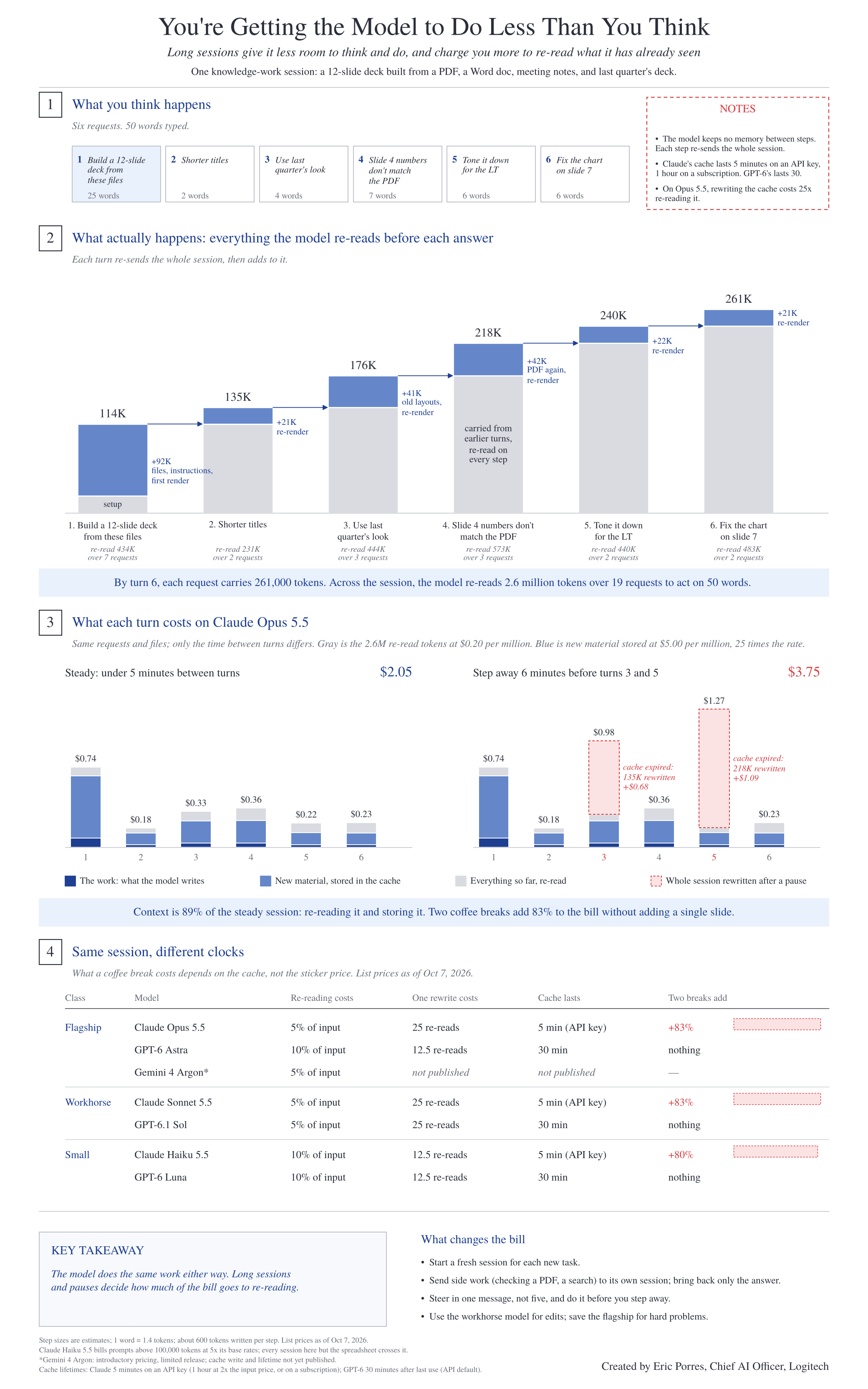
The first turn loads about 92,000 tokens of source material and instructions, writes a build script, and renders all 12 slides to check them. Every revision after that renders the deck again, about 18,000 tokens of slide images each time. “Slide 4 doesn’t match the PDF” sends the model back to read the PDF a second time. By turn 6, each request carries 261,000 tokens to act on six words. Your words are 0.003 percent of what it reads.
The number under the bars matters more than the one on top. Every turn is several requests (open the PDF, render the slides), and each request re-reads everything before it. Across the whole session, the model re-reads 2.6 million tokens over 19 requests. That’s the binder, read aloud nineteen times.
On Claude Opus 5.5 at list prices as of October 7, that session costs about $2.05. In dollars, the re-reading looks small (2.6 million tokens at $0.20 per million is $0.52) because Anthropic made re-reading cheap. The bigger line is filing: every render and every second read of the PDF is written into the cache at $5.00 per million, $1.31 in all. Carrying the context, reading it and filing it, is 89 percent of the bill. The part you’d call “the work,” the tokens the model writes, is 11 percent.
The step sizes are my estimates of a typical session, and the card says so. The shape doesn’t depend on them. Change any number by half and the ladder still climbs.
The coffee break
The second thing the card shows surprised me more than the first.
A cache doesn’t last forever. On a Claude API key, the default is five minutes; on a Claude subscription, an hour. If you step away to review the deck — the responsible thing to do — the cache expires. When you come back and type “tone it down,” the whole session gets written into the cache again, at the write price.
On Opus 5.5, writing to the cache costs $5.00 per million tokens and reading from it costs $0.20. Anthropic’s launch post has the same ratio: “One write costs as much as 25 reads.” Step away for six minutes before turns 3 and 5, and the same six requests cost $3.75 instead of $2.05. Two coffee breaks add 83 percent to the bill without adding a single slide.
The most expensive moment in a long session is often the moment you come back to it.
Three more sessions
I built the same card for three more sessions, and the pattern held each time.
Adding a feature to an existing app. Six requests: add CSV export to the Orders page, match the button style, handle empty orders, use our date format, add tests, and “CI failed, here’s the log.” It ends at 158,000 tokens. The work is 19 percent of the bill.
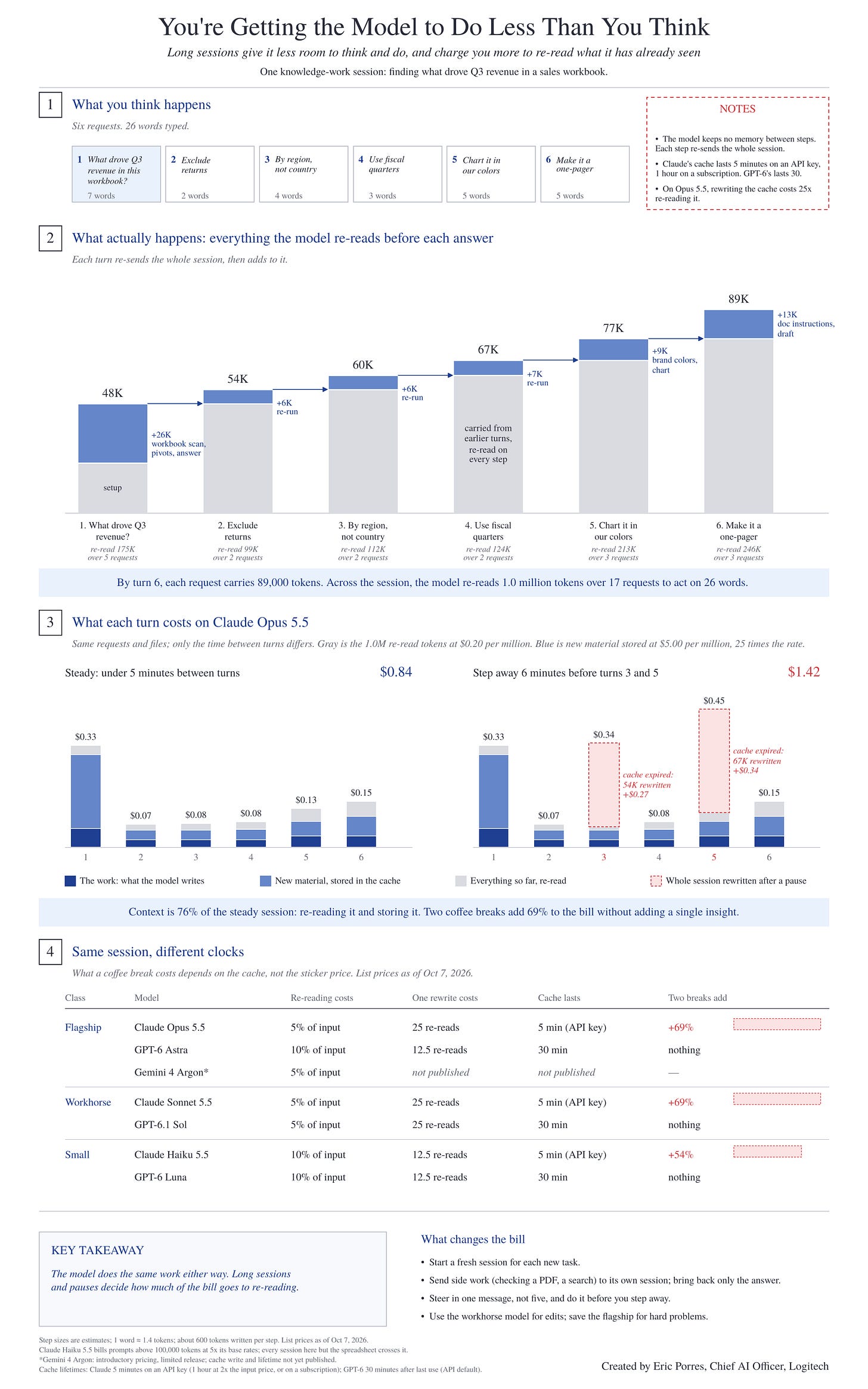
Building a data pipeline. Training runs dump 25,000 tokens of logs into the session each time. It ends at 203,000 tokens. The work is 14 percent.
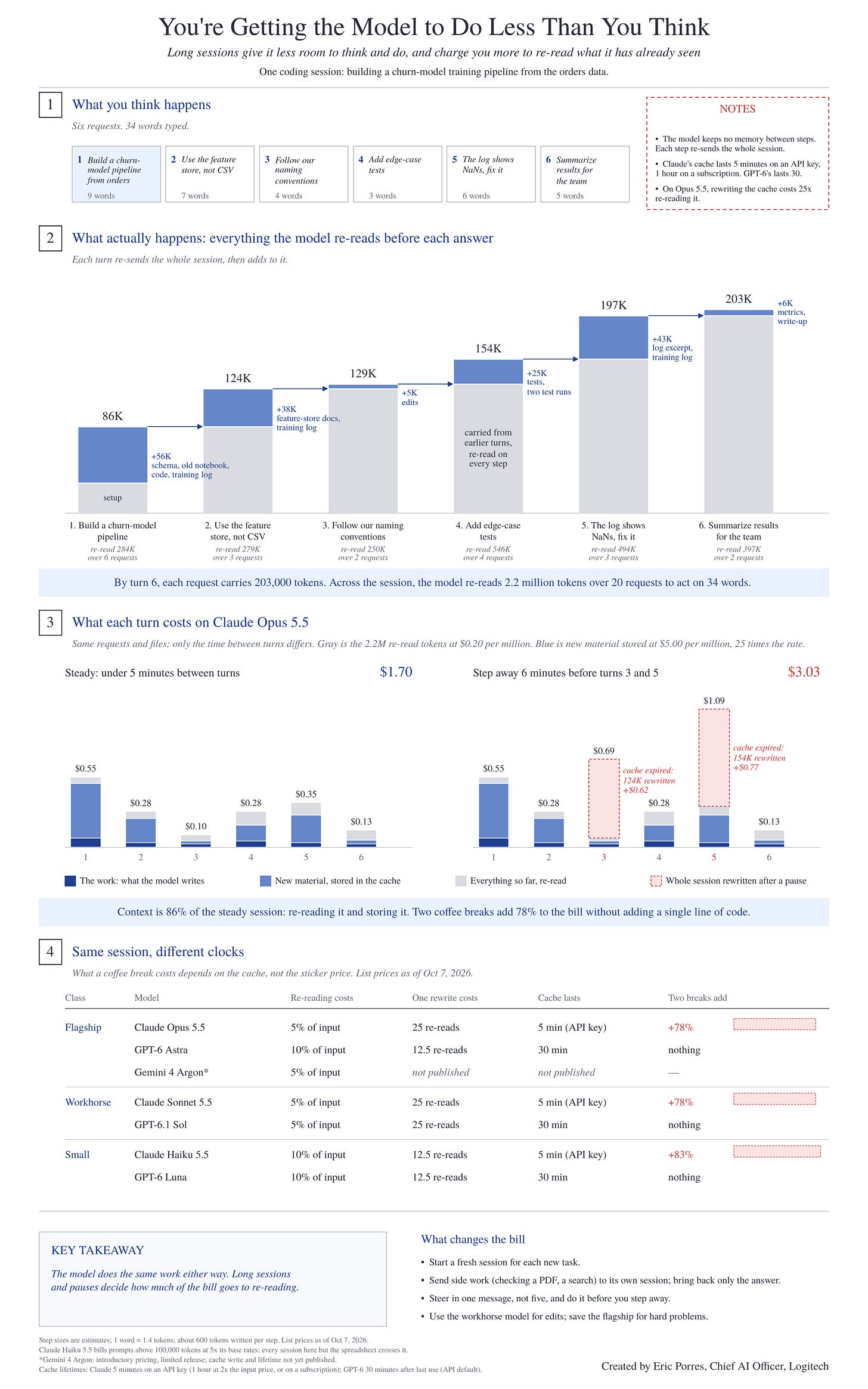
Analyzing a sales spreadsheet. The model runs small calculations and reports small summaries, so each step stays light. It ends at 89,000 tokens. The work is 24 percent, the best of the four and still under a quarter.
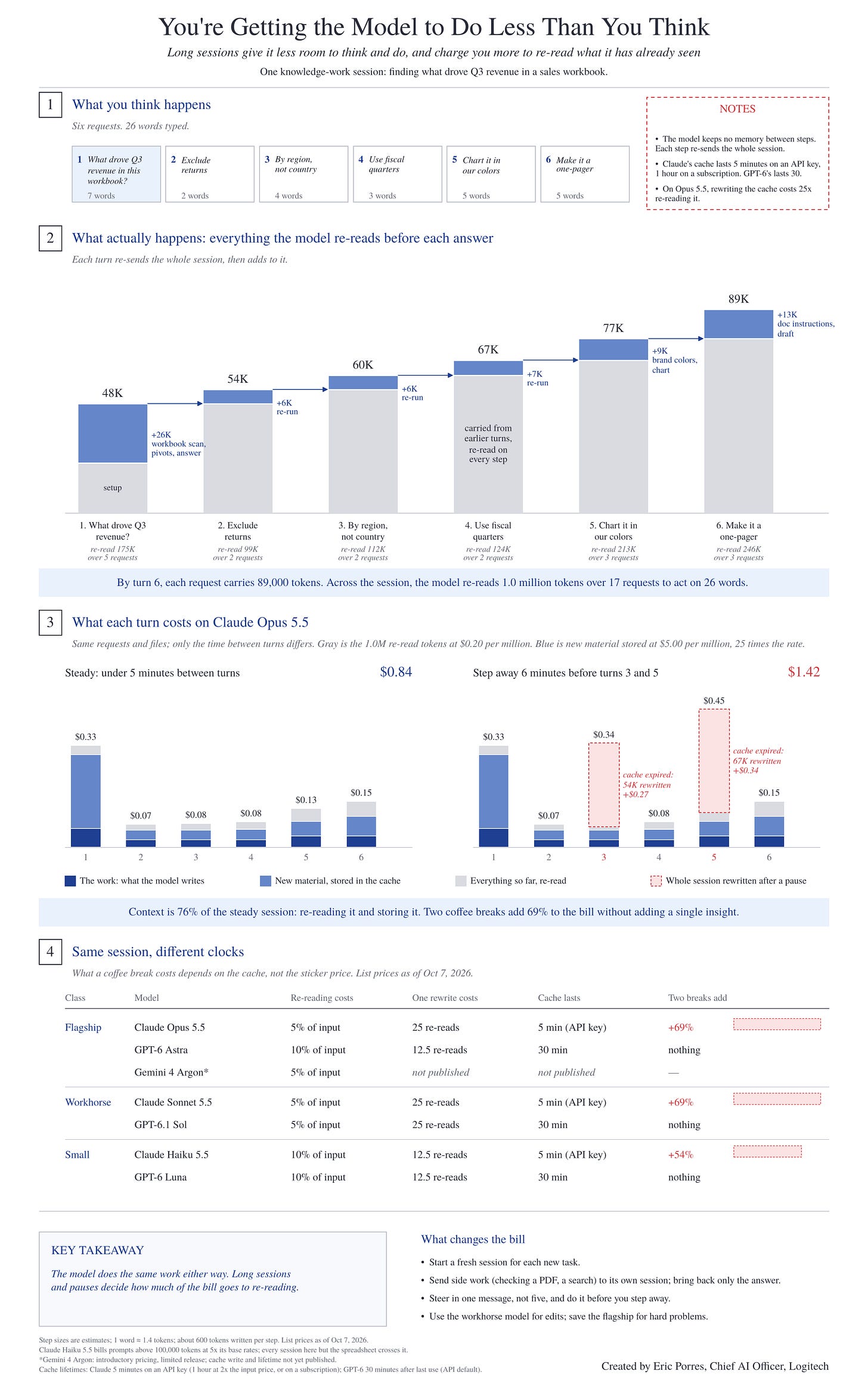
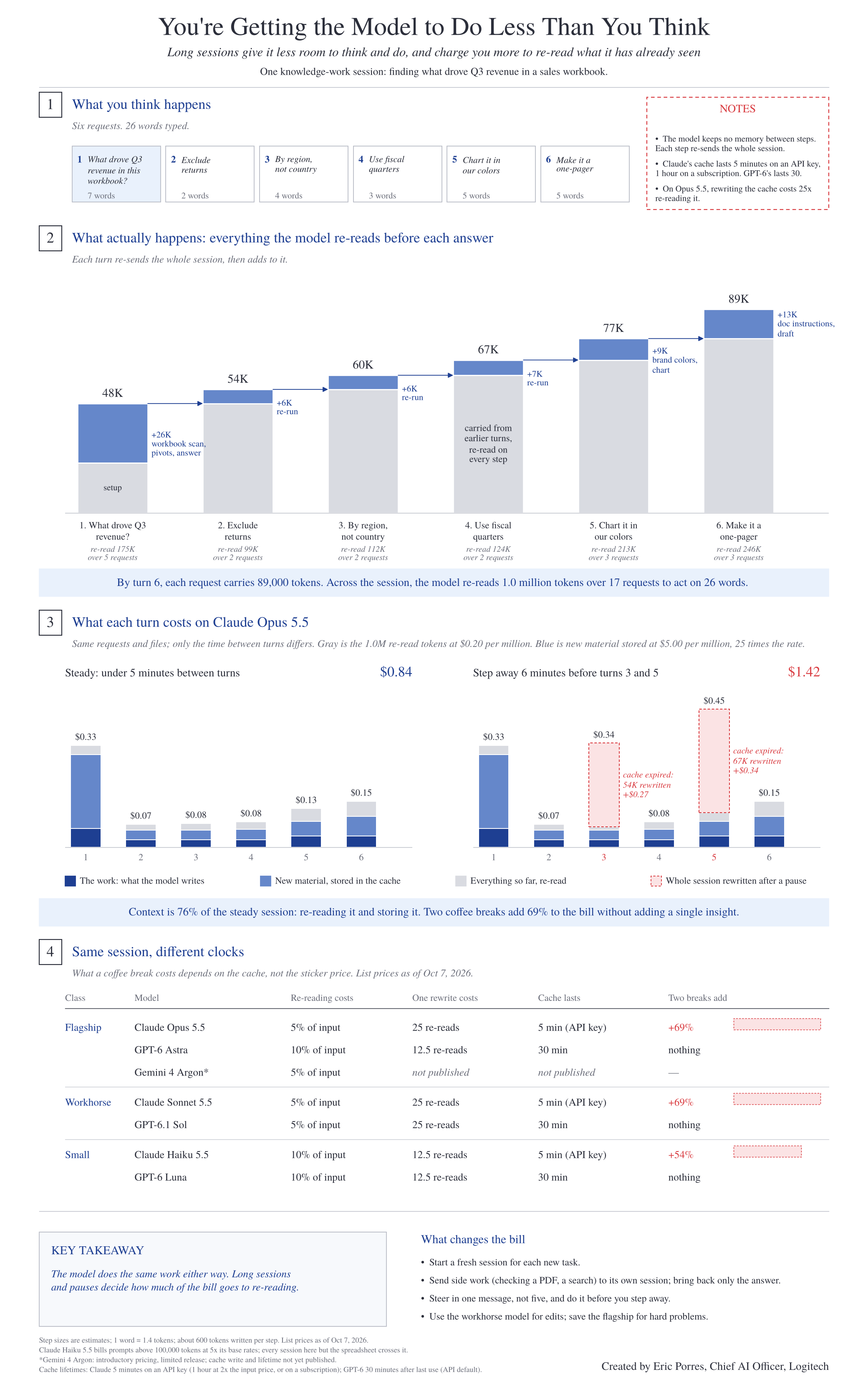
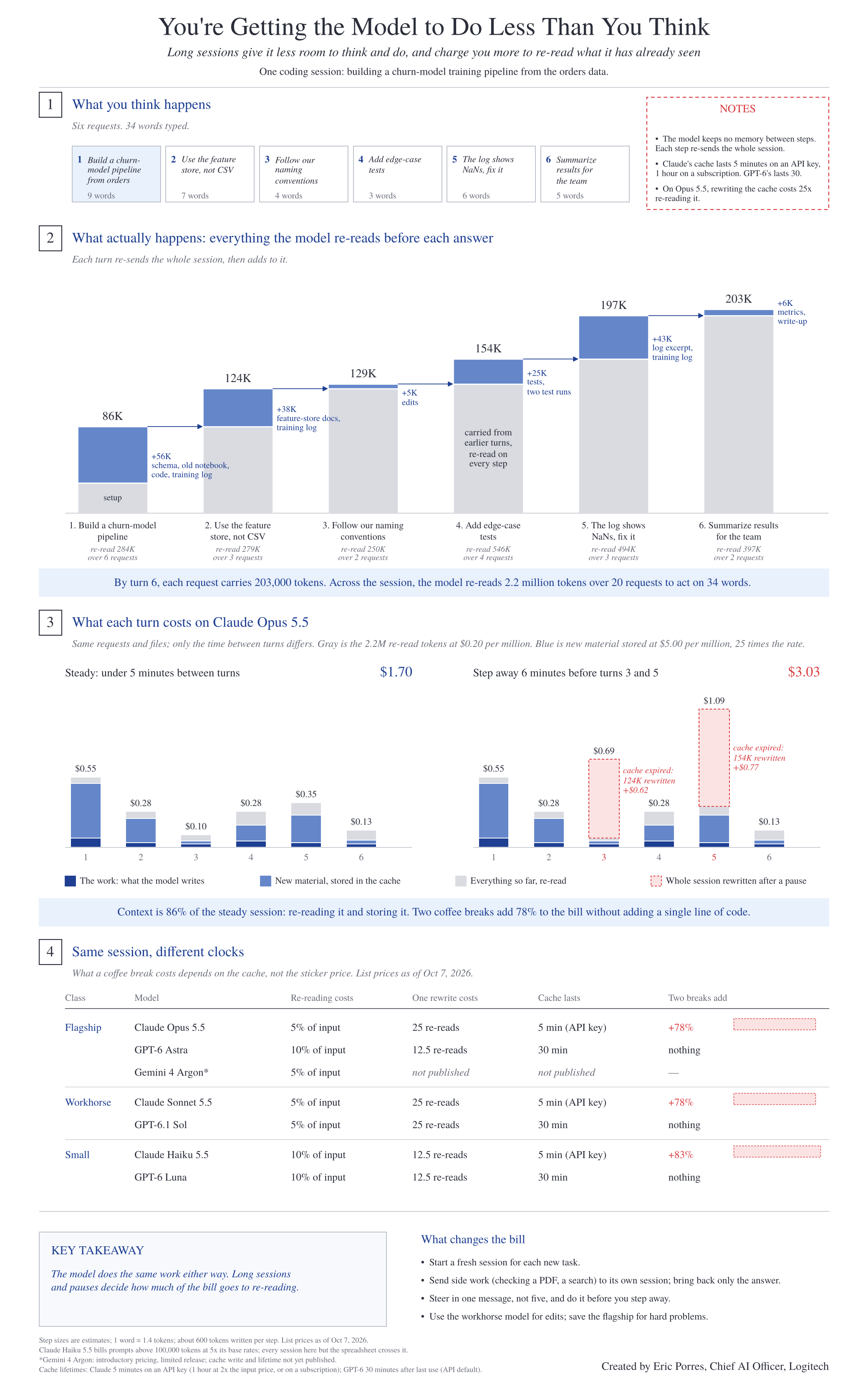
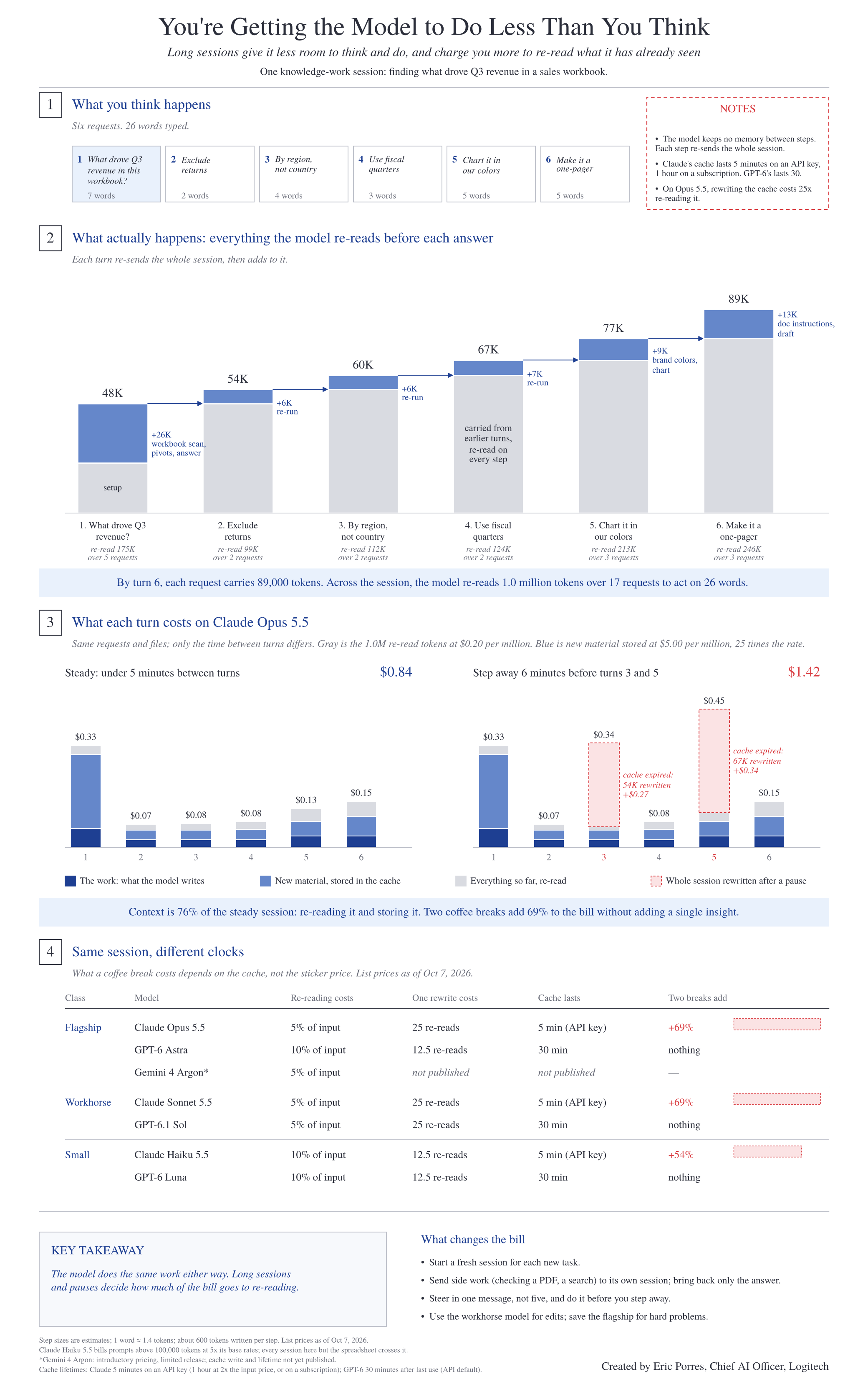
The spreadsheet is the one worth a second look. The question isn’t simpler than the deck’s; nothing in the session is large. There are no rendered slides, training logs, or second reads of a PDF. What each step drags in matters more than how many steps there are.
Same sticker, different clock
Four launches in eight days reset the rate cards. Anthropic released Claude Opus 5.5 on September 22 and cut cache reads 60 percent, from $0.50 to $0.20 per million tokens. The launch post makes the argument of this piece in three sentences: “Two models with the same cost per token can cost very different amounts on the same task. One reads the code once. The other reads it, tries a fix, and reads it again.” OpenAI shipped GPT-6 Sol and GPT-6 Luna the same day and GPT-6.1 Sol a week later. Anthropic answered with Claude Sonnet 5.5 on September 28. Google announced Gemini 4 Argon on September 30 at introductory prices, in limited release.
Some of those numbers moved again the day before this went out. On October 7, Anthropic released Claude Haiku 5.5 at a tenth of Haiku 4.5's price for prompts under 100,000 tokens, and halved Sonnet 5.5's cache read. That’s why the last section of each card shows ratios and clocks instead of prices. They move slower.
The mid-tier sticker has converged. Sonnet 5.5, GPT-6.1 Sol, and Argon's introductory rate all charge $2 per million tokens in and $10 per million out. Since Anthropic's cut, Sonnet 5.5 and GPT-6.1 Sol match on the cache too: a re-read costs 5 percent of the input price, and one rewrite costs 25 re-reads, the same ratio as Opus 5.5. Run the steady deck session on either and it costs $1.03.
Then the clock decides. OpenAI holds a GPT-6 cache for 30 minutes after its last use, so a six-minute coffee break costs nothing extra there. On a Claude API key the cache lasts five minutes. With both breaks, the deck costs $1.87 on Sonnet 5.5 and still $1.03 on GPT-6.1 Sol: the same rate card, and nearly twice the bill. Two breaks add 83 percent on Opus 5.5 and Sonnet 5.5 alike. On any GPT-6 model they add nothing. Google hasn’t published Argon’s cache-write price or cache lifetime, so it’s the one row on the cards I can’t score yet.
The flagship gap is still wide. OpenAI’s flagship is GPT-6 Astra, released September 3 and the model behind Astra, the ChatGPT collaborator I wrote about last week. On the steady deck session, Astra costs $6.42, three times Opus 5.5, largely because it charges $1.00 per million to re-read. Take the two breaks and its 30-minute clock narrows that to 1.7 times. The cache lifetime is part of the price.
Perfect context, every time
I get asked what I’m doing when I start a session with Deep Memory, the system I first wrote about in March. My short answer has been: building perfect context every time, so I avoid context bloat and give the model room to think and do. I drew the fifth card to check whether that answer holds up, using a task most managers will recognize: answering a budget request that depends on decisions made months ago.
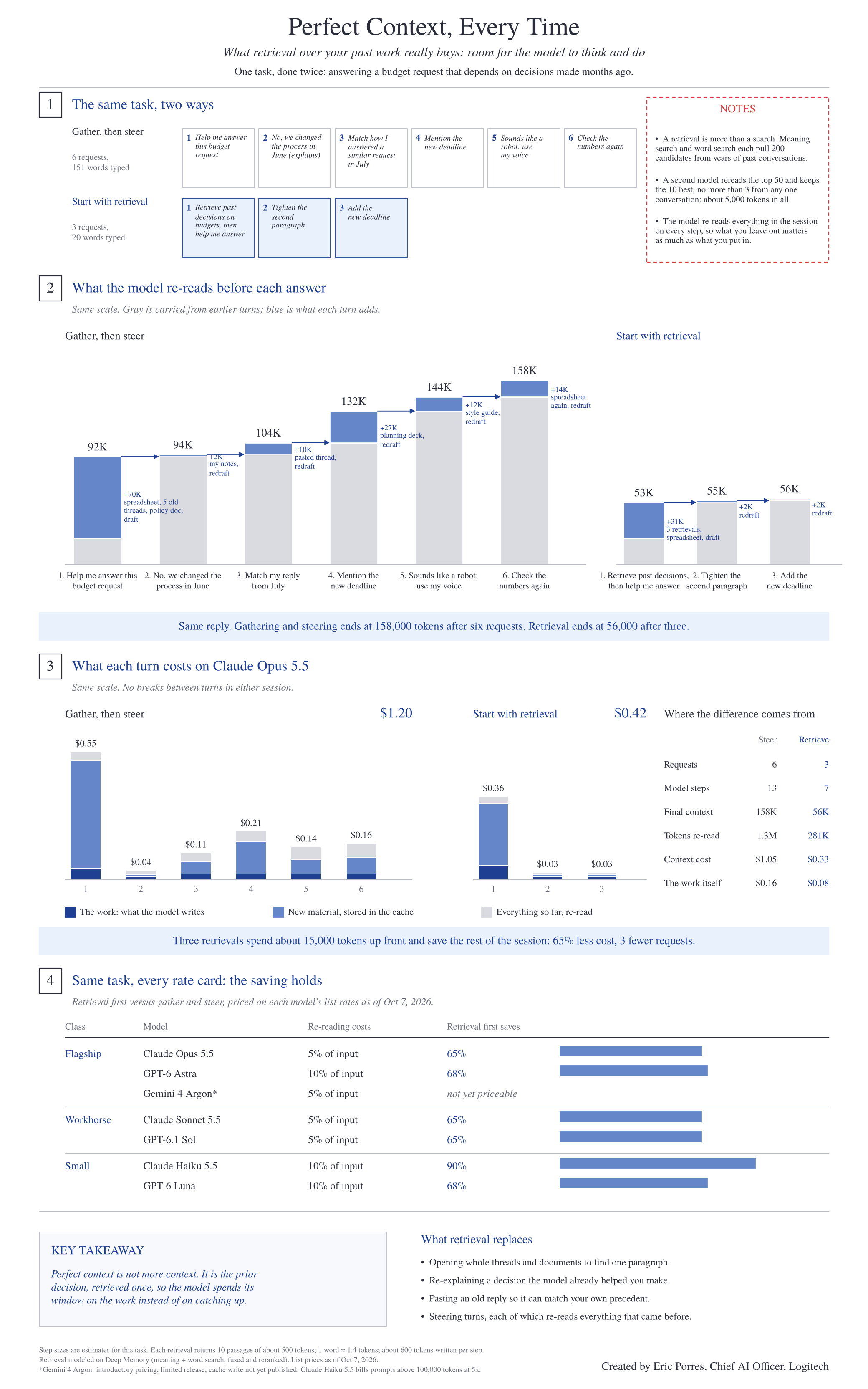
The first way is how most of us work. Ask for a reply. The assistant opens the spreadsheet, five old email threads, and the policy document to find the rule. Then you steer. “No, we changed the process in June,” and you explain it. “Match how I answered a similar request in July,” and you paste the thread. “Mention the new deadline,” and it opens the planning deck. “Sounds like a robot.” “Check the numbers again.” Six requests, 158,000 tokens by the end.
The second way starts with retrieval over your past work. One retrieval searches years of conversations by meaning and by keyword, has a second model rerank the finalists, and returns ten passages, about 5,000 tokens: the decision from June, the rule as you wrote it, the reply you sent in July. Not the threads they lived in. Three retrievals, then the spreadsheet and a draft. Three requests, 56,000 tokens.
The reply is the same, for 65 percent less cost and half the requests. On Haiku 5.5 the saving is 90 percent: the long session crosses the 100,000-token line where Haiku's price jumps fivefold, and the retrieval session never does.
Next week I’ll show you how that retrieval is built: what goes in, how it searches, the answer key I test it against, and why, after planning to give the code away, I kept it.
Perfect context means the prior decision, retrieved once, so the model spends its window on the work instead of on catching up. That’s the discipline I was pointing at in the context-engineering piece back in June: titles churn, and the work of choosing what goes in front of the model stays.
“It’s two dollars”
Two dollars for a deck, forty cents for a reply. Who cares?
Sure. The same way a two-dollar coffee is a rounding error until you look at a year of receipts. Ten sessions a day for a working month at the deck’s coffee-break price is about $800, spent on one person’s habits. And the dollars are the smaller half of the argument. A session carrying 261,000 tokens to act on six words is a model spending most of its attention catching up. I can’t show you a clean benchmark proving the long session produces a worse deck, so treat that as my working hypothesis. It matches what I see: the fresh session answers the question I asked, and the long one answers the whole history.
Shorter answers, same binder
The fix many people reach for first is a plugin that makes the model “talk less.” Caveman is a popular one. It rewrites the model’s replies, and some of its thinking, into clipped fragments. One engineer asked me about it in August, and another in early October, and my answer was the one these cards make: Caveman compresses output, and the bill is input. The work the model writes is 11 to 24 percent of the bill. Cut it in half and the deck session drops by about a dime, out of $2.05. The binder doesn’t get any thinner, because the replies were never the bulk of it. The bulk is the PDF, the renders, and every log tail that lands in the session and rides along on every request after. And in a debugging loop (or a policy draft), the articulate model is the part you’re paying for.
Decision models are a new class worth a look, but they solve a different problem. TypeSafe’s Jev, which went viral last month, returns a typed answer with a probability instead of text: urgent or not, which team, how severe. It’s served through an API that OpenRouter, Portkey, and others now carry, and TypeSafe bills only the input; the answer is free. Cloudflare followed on October 1 with Clef and Clef-flash, open-source and Jev-compatible, and reports they answer in about 200 and 40 milliseconds against Jev’s roughly 500. And on October 6, OpenAI opened its Decisions API to everyone in public beta. These don’t shrink the binder. They take steps out of it. “Which team owns this ticket” never needed a flagship re-reading the whole session, which is tip 5 below taken to its end. Notice why they’re fast, too: Jev reads at most 32,000 tokens and Clef 64,000. They work because someone handed them a small, chosen state. Same discipline, enforced by the model.
What you can do tomorrow morning
You don’t need a retrieval system for most of this. I built mine because I have nearly four years of conversations to search over 21 different systems, and next week’s piece is the blueprint for building your own. What it does for me, putting the right paragraph in front of the model and leaving the rest out, you can do by hand in Claude, ChatGPT, Codex or Gemini. In order of how much they move the bill:
Start a fresh session for each new task. The cheapest fix and the biggest: the binder resets to zero. In a chat app it’s the New chat button; in Claude Code,
/clear; in Codex,/new. Before you leave, ask the old session for five lines on what was decided, and paste them into the new one. Inside a long task,/compactin either tool swaps the transcript for a summary. It reads the whole session once to write it, so use it at a natural break, and don’t wait for Claude Code to compact on its own when the window fills.Put standing context in a file, not the conversation. Instructions you repeat every session belong in
CLAUDE.mdfor Claude Code,AGENTS.mdfor Codex, or project instructions in the Claude and ChatGPT apps. The file is re-read on every step too, so keep it short, point to documents instead of pasting them, and write down the decisions you’d otherwise re-explain. That file is the do-it-yourself version of my retrieval.Steer in one message, then take the coffee. List every change before you step away, and ask for a short handoff: decisions, open items, next step. If you come back after the cache has expired and the next step doesn’t need the old files, start fresh with the handoff instead of paying to rewrite the whole session.
Look at what you’re carrying.
/contextin Claude Code and/statusin Codex show how full the window is and with what. In a chat app, the tell is a long thread with files attached.Match the model to the step.
/modelswitches in Claude Code and Codex; every app has a picker. “Shorter titles” belongs on the workhorse. Save the flagship for the hard reasoning.
My answer to the engineer starts with the exercise I ran on myself: look at what the model re-read before it answered.
A bigger tier buys a thicker binder. Shorter sessions buy more work. The model is doing less than you think, and the length of the session is yours to set.
For readers who decide with receipts:
Anthropic, Claude pricing and What's new in Claude Opus 5.5, September 22, 2026. Opus 5.5 at $4 input, $20 output, $5 five-minute cache write, $0.20 cache read per million tokens (Opus 5 was $5, $25, $6.25, $0.50). Introducing Claude Sonnet 5.5, September 28, 2026: $2, $10, $2.50, $0.20; cache read halved to $0.10 on October 7. Claude Haiku 5.5, October 7, 2026: $0.10, $0.50, $0.125, $0.01 for prompts up to 100,000 tokens, five times that above (Haiku 4.5 was $1, $5, $1.25, $0.10). Claude's API also offers a one-hour cache write at 2 times input ($8 on Opus 5.5, $4 on Sonnet 5.5); the cards price the five-minute option.
Addy Osmani for Anthropic, What a task costs on Opus 5.5, September 22, 2026. The per-task framing, the 60 percent cache-read cut, and cache lifetimes in Claude Code: one hour on a Claude subscription, five minutes on an API key.
OpenAI, Prompt caching: on GPT-5.6 and later, cache writes at 1.25 times the input rate and a cache lifetime of 30 minutes after the latest write or reuse, the API default (
prompt_cache_options.ttl).VentureBeat on GPT-6 Sol and Luna, September 22, 2026: Luna at $0.10, $0.50, $0.125, $0.01. OpenAI, Introducing GPT-6.1 Sol, September 29, 2026: $2 input, $0.10 cached input, $10 output; $2.50 cache write per Developers Digest.
VentureBeat on Gemini 4 Argon, September 30, 2026: introductory $2 input, $10 output, $0.10 cached input (later $4, $20, $0.20); limited release; cache-write price and lifetime not published.
CloudZero on GPT-6 Astra pricing: $10, $50, $12.50, $1.00, released September 3, 2026, with a long-context surcharge above 272,000 input tokens. None of the modeled sessions crosses it.
Anthropic, Claude Code commands:
/clear,/compact,/context,/model. OpenAI, Codex slash commands:/compact,/status,/model;/newper the Codex CLI command reference.The AI Field Guide, Card 02 (Caching, Cost, and Latency) and Card 05 (The Context Window Is Not Memory). These new cards zoom in on what Card 02 shows at altitude.
The five cards are modeled sessions. Step sizes are my estimates; each retrieval returns ten passages of about 500 tokens; one word is about 1.4 tokens; about 600 tokens written per step. Step-away prices use each provider's published cache lifetime. The last section of each card shows ratios and cache lifetimes as of October 7, 2026, rather than per-vendor dollars; Gemini 4 Argon is listed but not simulated until Google publishes its cache terms.
Decisions Decisions!
Subscribe to Beyond Reason for more from the practitioner side of the machine.