

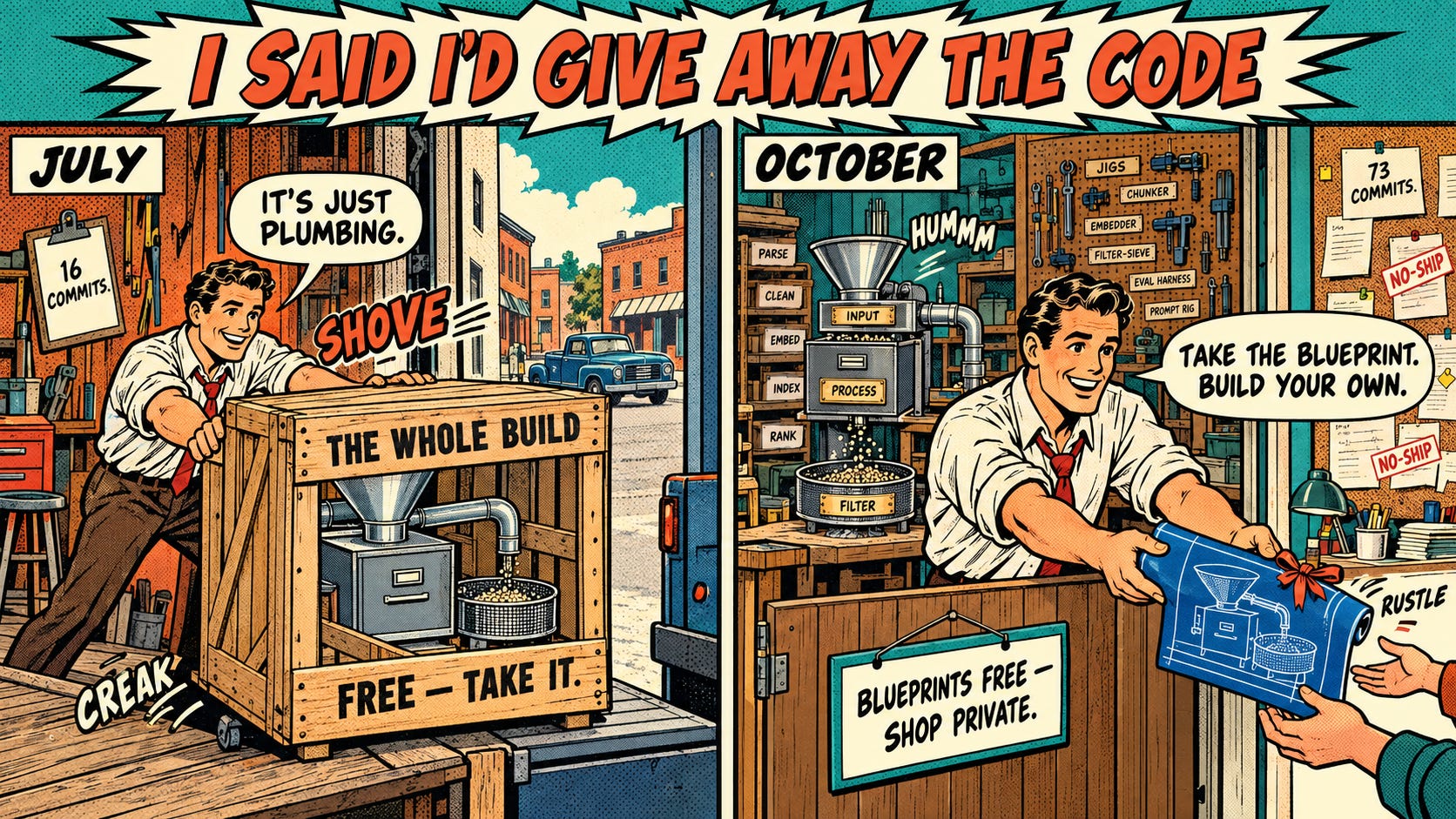
TL;DR: In July I finished an essay called “The Moat Was Never the Code” and scheduled my memory system’s repository to go public with it. The system had matched the strongest open-source memory project on its own benchmark, and my argument was that the pipeline was a commodity and the asset was three years of my own conversations. I didn’t ship it. Since then the private repository has taken 87 more commits, and most of them encode a judgment I earned by getting something wrong. That changes what the code is. So this piece gives you the architecture, the evaluation discipline, the operating rules, and the LongMemEval protocol, in full. The build stays private.
Over the Fourth of July weekend, my memory system made a decision for me while I slept.
I was building TrialThread, a free clinical-trial finder, with Claude. At 4 AM the open question was whether to open-source it. Claude searched my conversation archive, found the answer I had reached three days earlier about a different project, and applied it: share it, because the value was never in the code. I woke up to a public repository and my own reasoning, cited back to me.
The different project was the archive itself. That week I finished a draft built on the same line, “The Moat Was Never the Code,” scheduled for August 11 with a link to the repository. The link never went live. The repository is still private, and it’s staying that way.
This is that essay, two months late, with the reversal in it. I owe you the reasoning. I also owe you what I promised two weeks ago: how it’s built. All of it is here except the code.
The argument I believed in July
In March I argued in “The Blank Page Is Not Deep Work” that the bottleneck in knowledge work isn’t the first draft. It’s finding the thinking you already did, in some Claude session in October. Or was it ChatGPT. Or was it November. I open-sourced a four-hundred-line keyword search that month, which is still on GitHub, and kept the semantic version on infrastructure I own.
By the end of June the semantic version was good. I ran it against LongMemEval, the 500-question benchmark the open-source memory projects report on, using the exact scoring rule MemPalace publishes. It found the right conversation in the top five 98.8 percent of the time with plain semantic search and 99.8 percent with a reranker. MemPalace’s published raw number is 96.6. The asterisk: my raw number rides a paid frontier embedder, and theirs rides a 90-megabyte model that runs free on a laptop, so I bought that gap with tokens, not cleverness. The whole run cost about a dollar.
The July argument followed from there. MemPalace has more than 59,000 stars on GitHub. Garry Tan’s gbrain has more than 30,000. If one person working with one model could post the same number as projects with thousands of forks, the value couldn’t live in the pipeline. It had to live in the corpus: approaching four years of my decisions, dead ends, and half-finished arguments, which nobody can clone. So give the pipeline away.
That argument was right about the code I had in July. Split, embed, store, fuse a keyword pass, rerank: that pipeline is a commodity, and I’m handing it to you below. What I didn’t see coming was the next three months.
Eighty-seven commits later
The repository had 16 commits when I started the July draft. It had 89 when I drafted this article nearly four weeks ago. Now it has 103. Eighty-seven of them landed after I started writing that the code didn’t matter.
Almost none made the search more clever. Three stories cover most of them.
The gate was grading the wrong road
The July draft bragged about my evaluation rule: no change to how the system finds things ships without a before-and-after on a fixed set of real questions. In September, Fable, my Claude collaborator, traced a slide in search quality to duplicate passages crowding out the results, and Astra, my ChatGPT collaborator, reviewed the fix. Three weeks ago I wrote about how they finished each other’s sentences on that repair. The part I left out was this: Astra’s review found that my everyday evaluation script had been testing the dense-only search path since June, while production ran hybrid search. It also found that my 25 semantic test answers had been seeded from the system’s own earlier results, and I had never confirmed them. My gate was grading a road the traffic no longer took, against an answer key the student wrote.
The July draft said a measurement you don’t audit launders a guess into a number. I still needed a second model to catch me doing it.
That fix lives in the code now. The evaluation suite has 87 cases, each checked against the exact source passage, with labels that can’t be widened after anyone sees a result. Ten cases the reviewers couldn’t settle stay marked unresolved instead of counted. The reference result is 72 of 77. On September 17 the gate turned down rerank-3, a newer reranker that lost ground on my semantic questions. The next day it turned down a ranking change that held the headline at 72 of 77 while dropping an accepted passage underneath. A headline-only gate, the kind I had in July, would have passed it.
The agent read half a thread
On July 3, an agent told me a question was still open. I had closed it later in the same thread. The right conversation ranked first; the agent read its older half and stopped. No retrieval metric catches that, because retrieval worked. So the fix went into the operating manual my agents load: before you call anything unresolved, ask for the fact in neutral words and chase the thread forward in time. In September the code caught up with the rule. Every passage now comes back with an ID and a SHA-256 fingerprint, and an agent can reopen the exact stored text, see who said it and when, and learn whether it has changed. A relevance score ranks. It doesn’t vouch.
Captured, indexed, found
The system started on nightly exports. It now pulls from 23 sources, including cloud sessions that exist on no disk of mine until a hook saves them as they end. Every capture is journaled before it’s indexed, the code tracks archived, indexed, and findable as three separate states, and the newest capture path doesn’t mark a conversation done until a real search returns it.
The reps moved into the code
The July draft said you could clone my pipeline in an afternoon but not the reps: the thousands of hours working alongside these systems until you learn their tells. I was right about the reps. I was wrong about where they would live.
They moved into the code. Each commit above is a judgment I made once, usually right after being wrong, written down where the system enforces it without me. The evaluation locks its labels because I once let the system write its own answer key. The agent reopens the source because one stopped reading halfway through a thread. The cloud capture fails out loud because a logged-out run once reported nothing new, as if nothing had happened.
Once code starts carrying your judgment, it stops being the part anyone can clone.
A public repository wouldn’t hand you that judgment anyway. The scrubbed snapshot I prepared in July is a single commit, already sixty behind, with the real names in my relationship graph swapped for fictional people and my sources swapped for placeholders. It’s a copy of who I was in July, fitted to a life that isn’t yours.
There’s also a simpler reason. This system is a superpower. In about a second it finds a decision I made months ago, shows me who I talk to about a project, and hands a fresh session the handful of passages it needs instead of the whole history, the perfect context I described earlier this month. I’m not sure I want to give that away, and I’m the one who wrote the essay saying I should.
Also in July, I argued that the companies that survive the agent era own the vault: the data, the workflow, and the custody an agent can’t cheaply rebuild. I named one bet against myself: the real vault might turn out to be the agent’s memory. I was writing about Salesforce. I was also describing my own repository. That piece had a rule for anyone who owns a vault: expose it, don’t wall it shut. So here is the exposure.
The blueprint
This is what I’d tell you if you asked me to help build yours, in order of how much it matters. Bring your own conversations and swap any component.
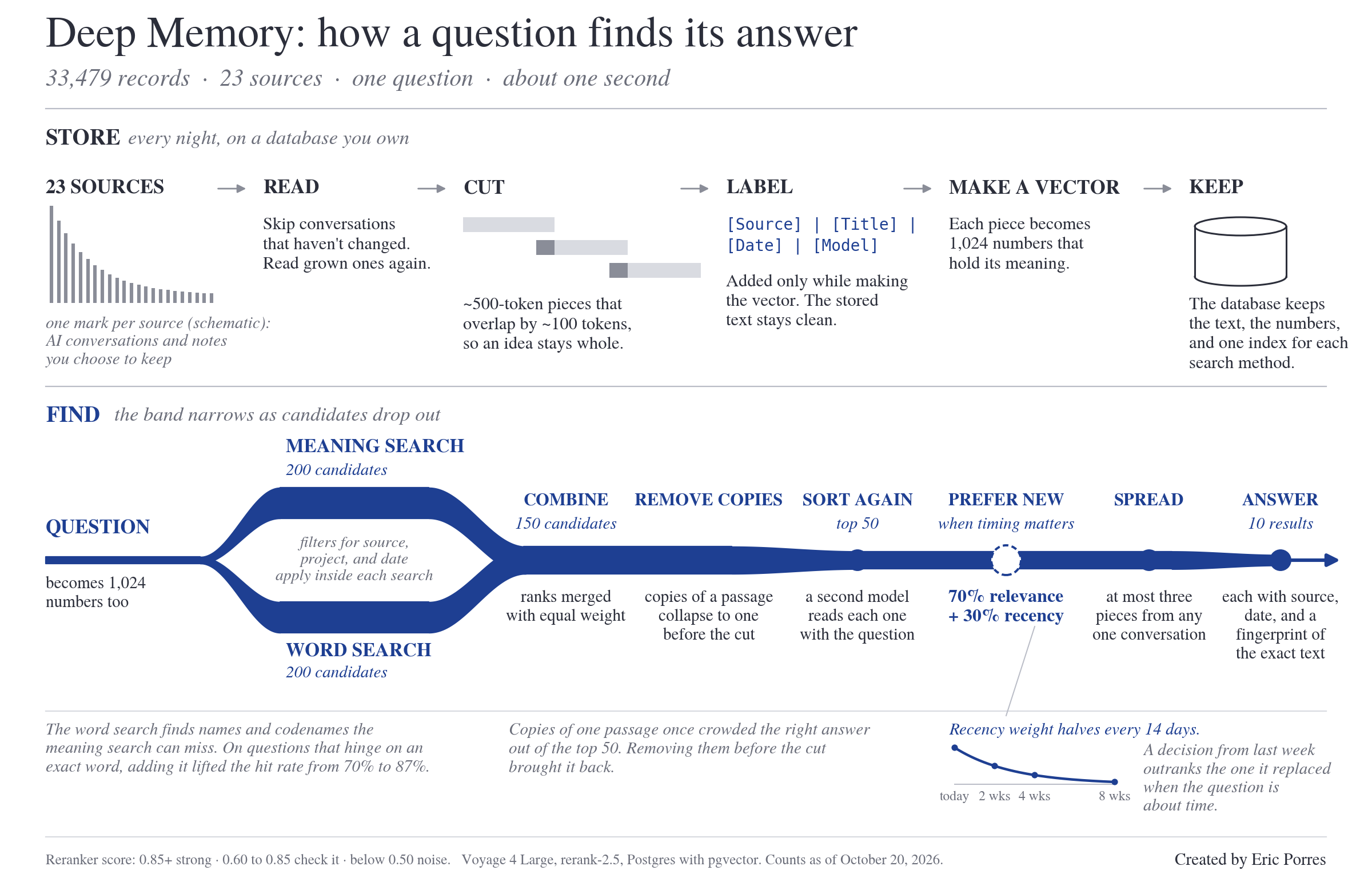
The whole path on one page. Steps 3 through 5 below, drawn.
Decide what counts as memory. Ingest records of thinking: your conversations, plus the syntheses you write on purpose. Leave out the files those conversations produced. The reasoning already lives in the thread, and a filename search finds the output. This choice shapes everything downstream. One boundary goes with it: your employer’s data stays in your employer’s systems.
Write the answer key before you tune anything. Collect 50 real questions you’ve asked and the exact passage that answers each one, and freeze them. No retrieval change ships without a before-and-after on that set, and every rejected change gets written down with the result that would reverse it. Mine has turned down a newer embedding model, a newer reranker, and a ranking tweak that held the headline score while losing a correct answer. Have someone other than the builder check the key; a second model counts.
Store it where you own it. Split each conversation into passages, embed each one (I use voyage-4-large at 1,024 dimensions), and keep the vectors in Postgres with pgvector. My database runs about $76 a month at the tier I use now, before embedding and reranking calls. Grow the disk before a big migration, never during, and write in small committed batches. I learned that one by knocking my own database read-only at eleven at night.
Search two ways, then let a reranker read. Run a meaning search and a keyword search, fuse the two lists with reciprocal rank fusion into about 150 candidates, collapse exact duplicate passages, and send the top 50 to a cross-encoder reranker (I use rerank-2.5). The keyword arm finds the names and codenames that embeddings blur. Collapse duplicates before the cut, or copies of one passage crowd out the answer. When the question is about time, blend 70 percent relevance with 30 percent recency, and let the recency weight halve every 14 days. A memory holds every decision you later reversed, and without the blend the old answer can outrank the new one.
Return pointers with receipts. Every result carries its source, speaker, date, and a fingerprint of the exact text. The agent reopens the passage before relying on it and treats the score as a rank.
Write the operating manual. The code builds the memory; a short skill file tells the agent how to use it. Three rules in mine have earned their place: a hit is a pointer, never the answer; before calling a question open, ask it again in neutral words and chase the thread forward in time; and an empty result means nothing matched, never that the search broke, so errors have to say they’re errors.
Then test it on a public benchmark. LongMemEval_s, all 500 questions, run MemPalace’s way: one document per session built from the user’s turns, a hit when any correct session lands in the top five, and their 50/450 split with seed 42 so you can report the 450 you never tuned on. My held-out raw score was 98.7 percent. Name the embedder you used, and say plainly that retrieval recall is not answer accuracy.
The benchmark comes last on purpose. It proves your pipeline works on someone else’s life. Steps one and two are what make it work on yours.
The join no lab can make
The labs spent this year reaching for the same thing. In March, Anthropic made Claude’s memory free and added a tool to import your history from ChatGPT and Gemini. In June, OpenAI shipped a feature it named dreaming, a background pass that reviews your conversations and curates what ChatGPT remembers. Google’s Gemini now reads your Gmail and Photos to answer as if it knows you.
Each of those memories lives on one company’s servers and sees one company’s slice of you. Mine joins sources no single company holds. The relationship graph Fable and I built in a day in July links each person, project, and company to the conversations that mention them. It also reads names, message counts, and recency from my text messages, never the content, to record how close I am to someone. Ask about a person and one card shows what we’ve discussed across every system I use and how often we talk. OpenAI doesn’t have my texts. Apple doesn’t have my ChatGPT history. That join gets computed in one place.
In March I argued for owning your context on principle. This is the practical payoff: some views of your own life only you can compute.
Alone, but not by myself
No other person has committed to this repository, and I was never working by myself. Claude Opus, versions 4.6 through 4.8, carried the long middle: the archive, the hardening, hybrid retrieval. Fable 5 arrived in June for the benchmark and the graph. Since September the record shows Opus 5 and Fable 5.1, and Astra, working in Codex, built the source-grounded evaluation and the newest capture path. Every one of those commits started as a conversation: I set the intent and the definition of done, a model proposed, and either the other model or I pushed back. The pushing back is where the system got good.
I know the reversal will hold because of how the archive answers. If a model searched my archive at 4 AM tonight, the way one did for TrialThread, it would find the July answer first: share it, the value was never in the code. Then it would follow the rule I wrote after July 3, ask the question again in neutral words and chase the thread forward in time, and it would find this essay. The July answer stays on the record. It just isn’t the last word anymore.
Take the blueprint and build your own. It will remember you better than mine ever could.
For readers who crave receipts:
“The Blank Page Is Not Deep Work” (Beyond Reason, March 31, 2026): the argument that retrieval, not generation, is the bottleneck.
“I Built a Clinical Trial Finder Over the July 4th Weekend” (Beyond Reason, July 7, 2026): the 4 AM open-source decision, applied from my own archive.
“Companies Have Tasks & Jobs, Too” (Beyond Reason, July 14, 2026): own the vault, and the bet that the vault might be the agent’s memory.
LongMemEval (Wu et al., October 2024): 500 questions on long-term interactive memory. My run used LongMemEval_s and MemPalace’s harness: user-turn session documents, recall-any at five, 50/450 split at seed 42. Raw 98.8 percent (494/500), reranked 99.8 percent (499/500), held-out raw 98.7 percent (444/450). This is retrieval recall, not question-answering accuracy.
MemPalace: the open-source memory system whose protocol I matched, 96.6 percent raw on LongMemEval with a local embedder; over 59,000 stars as of October 20. Link only the official repository; an impostor domain has circulated.
gbrain: Garry Tan’s agent brain, over 30,000 stars as of October 20, 2026, with a knowledge graph and features mine doesn’t have.
deep-memory v1: the March keyword search, still open source.
Anthropic’s free memory and import tool, March 2, 2026 (9to5Mac); OpenAI, “Dreaming: Better memory for a more helpful ChatGPT”, June 4, 2026; Google’s Gemini Personal Intelligence, January 14, 2026 (Fortune).
Voyage AI: voyage-4-large embeddings and the rerank-2.5 cross-encoder.
Repository figures come from the private repository’s history and decision log as of October 20, 2026: 103 commits, 16 through June 30 and 87 since July 2; evaluation suite 2.2.0, 87 cases, reference 72/77; rerank-3 rejected September 17; ranking serializer rejected September 18; database cost is the illustrative monthly total for the current tier, excluding embedding calls and tax.scale
Subscribe to Beyond Reason for more from the practitioner side of the machine.
[scale] Scale, approximate. In March the system held 4,485 conversations from 12 platforms, about 77,000 searchable passages. As of October 20 it holds 33,479 records from 23 sources, about 301,000 passages by the database’s own estimate. Records include AI conversations and the other sources I’ve chosen to capture. Counts measure what’s indexed, not what’s complete.
NEW (2pm Oct 20): A Blueprint Skill
Bonus content for today’s readers: someone pointed their agent at this article and ran a blueprint evaluation on their knowledge base. It was good, but could be better, so I’ve added a new Github repository with a blueprint skill:
https://github.com/ericporres/second-brain-blueprint
Note: I evaluated the skill first before shipping it. Enjoy.
Bonus content for today's readers: someone pointed their agent at this article and ran a blueprint evaluation on their knowledge base. It was good, but could be better, so I've added a new Github repository with a blueprint skill:
https://github.com/ericporres/second-brain-blueprint
Note: I evaluated the skill first before shipping it. Enjoy